Feeling slowed down? That’s the point. Kalamazoo crashes drop 25%.
Kalamazoo’s traffic calming makes roads safer for everyday mistakes, while enforcement targets truly dangerous driving.
Sometimes, either/or arguments just don’t apply.
Like:
You need to drive the speed limit, keep your eyes on the road, obey all signs, laws, and ordinances. And if you can’t or won’t, you should be pulled over and ticketed.
Or:
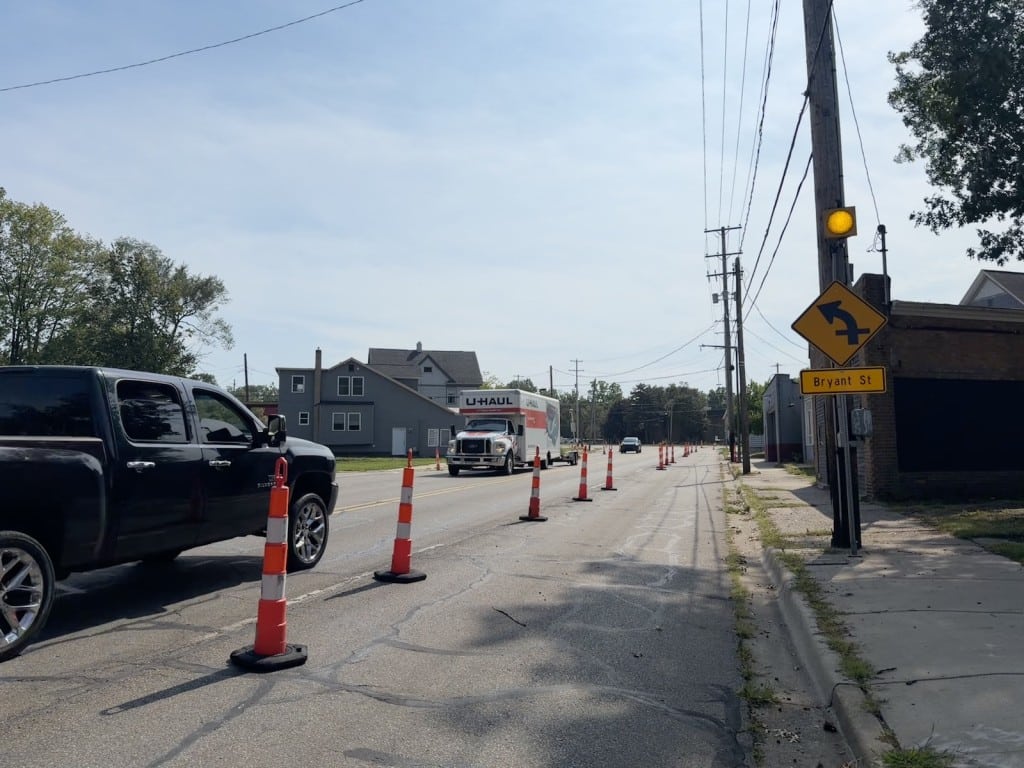
People make mistakes. Therefore, we should redesign our roads and streets so they’re not easy to speed on, to slow drivers who might creep above the speed limit, to draw their attention to the task of driving.
But why not both?
What if we take both approaches in Kalamazoo: traditional traffic enforcement, plus traffic calming?
The goal should be to reduce fatal and severe crashes, the City of Kalamazoo and Kalamazoo Public Safety agree.
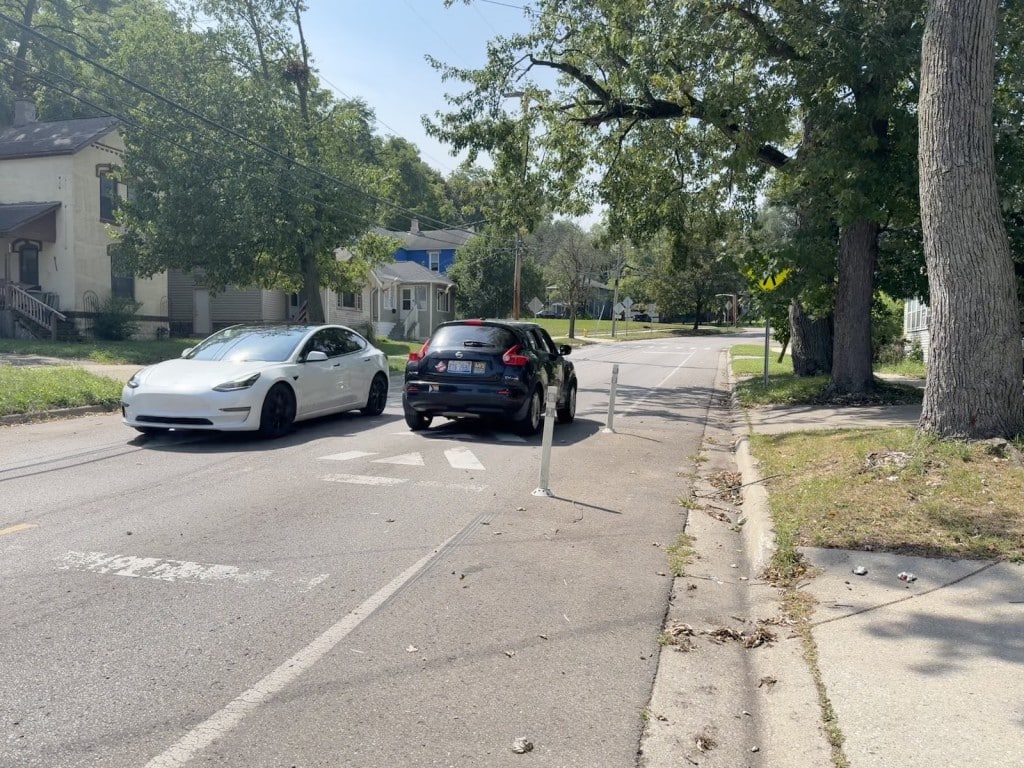
Therefore, the City engineering department and the KDPS have been working together to target scofflaws and redesign streets so the rest of us don’t fall into dangerous habits.
From speed bumps to a new computer system that pinpoints speeding to the two-way conversion underway, the City and the KDPS are working to prevent speeding — intentional or not.
Enforcement
In 2024, Second Wave spoke with West Main residents. They were tired of traffic speeding way above the 35 MPH speed limit, flying down the hill towards Downtown and along the curve near Mountain Home Cemetery.
They’d seen countless wrecks. Some demanded speed cameras for ticketing, a zero-tolerance attitude from the KDPS toward speeding, traffic officers armed with radar guns, etc.
Speed cameras, however, are currently only allowed in Michigan construction zones.
And as for traffic officers increasing enforcement, well….
KDPS has only one full-time traffic officer, KDPS Assistant Chief Matthew Huber says. Huber oversees the KDPS traffic division.
In 2012, due to budget cuts and staff reductions, “we lost all our traffic enforcement officers,” he says. It was in 2019 when they managed to get one on staff.
“We’re trying to look forward to the future, and hopefully next year it’ll include two traffic officers,” he says.
Huber clarifies that this does not mean there’s little traffic enforcement. Officers on the streets will pull over violators if they aren’t on a call to something else. They take 300-400 calls-for-service a day, and 911 calls are their top priority, he says.
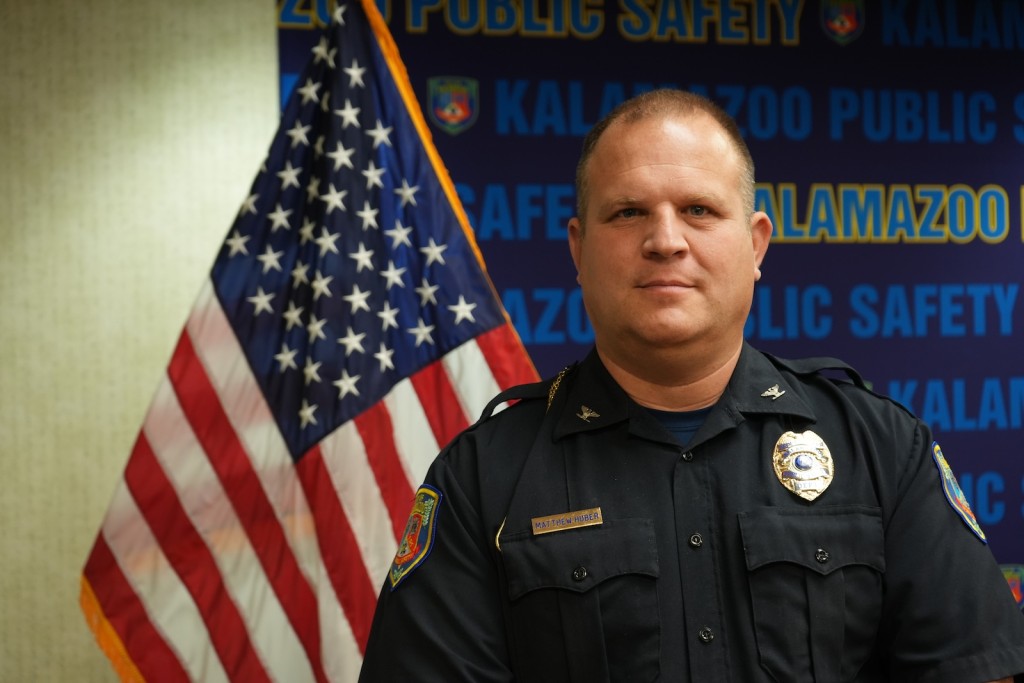
KDPS made around 9,500 traffic stops last year. Huber says, “Our number one citation issued for a traffic stop is speeding.”
Talking with residents and perusing comments on social media, one might get the perception that drivers in Kalamazoo have been much worse after COVID. Is there any evidence this is the case?
“I can’t say that people are driving worse in Kalamazoo; I don’t have any data on that. But definitely I can understand how people feel that way,” Huber says.
If we did have more enforcement — say, more officers with a radar gun parked conspicuously at a high-traffic spot — wouldn’t that help slow people down?
Huber thinks of I-94, where “you see state troopers in the median; that’s what slows down the traffic. But it only slows down for so long, and when they’re comfortable, again speed starts creeping up.”
A “visual deterrent,” he says, “only lasts so long.”
Sometimes people simply forget that they could be ticketed, that they are breaking the law once they get above the speed limit. Once the cop cars are out of sight, “people feel more comfortable doing it,” Huber says.
Urban SDK — macro traffic monitoring
Since we can’t have officers on the street everywhere 24/7, Huber says the KDPS has been partnering with the City to bring Urban SDK online this summer.
Described on its site as a “geospatial AI” method of traffic monitoring, Urban SDK can highlight streets where speeding is an issue. It works like Google Maps’ ability to highlight traffic slowdowns and jams on interstates, Huber says, by analyzing real-time data from cell phones and vehicle systems.
Unlike speed cameras, it can’t be used to target individuals, he says. It doesn’t collect identifying data from drivers. “It just gives an average, or an aggregate speed.” It shows average speeds on streets, plus days and times when speeding happens.
“It’s been very beneficial so far to help direct us to where we want to do enforcement, and help traffic engineers as well about how they want to set up future traffic calming measures,” Huber says.
Huber is all for traffic calming — he’s a big fan of new crosswalk signals in Traverse City that flash red, like a train crossing, when a pedestrian is crossing.
Traffic calming infrastructure, plus enforcement, “complement each other for the most part. The traffic calming helps everyday drivers use the road, and avoid the unintentional creeping above the speed limit,” Huber says.
If most drivers can keep to the speed limit, “the police officers out there doing traffic enforcement can focus on the drivers who disregard the traffic laws or do more dangerous conduct,” he says.
“I’m definitely not a traffic engineer by any means, but I think (traffic calming) does have its place. A police officer can’t be doing traffic enforcement 24 hours a day on every road, you know, within the city.”
Dangerous by design?
As another method of letting the public know they’re on the streets looking for scofflaws, Huber points out KDPS’s reality-show-style YouTube series, “Riding with CPOs” and “Riding with Gonzo.”
In one “CPOs” episode posted in August, a sting is set up after residents complain about drivers not stopping for pedestrians at the crosswalk on West Main and Woodward.
They have a KDPS undercover “pedestrian” put himself at risk by carefully crossing.
Multiple lanes of drivers speed past the walker; one chirps their brakes as they nearly hit him, others go around him, and only one stops completely.
CPO Matt Gernaat, observing, pulls over the driver who nearly hit the officer/pedestrian. Gernaat explains to the driver that if anyone is in the crosswalk, drivers must stop until the person reaches the other side of the street. It’s a city ordinance. Breaking it results in a civil infraction.
The driver says he slowed down, and he didn’t know it was a crosswalk. “I wasn’t trying to hit him or nothing,” the driver tells Gernaat.
The officer points out that there are signs and road markings for the crosswalk.
“How are we supposed to see it?” the driver asks.
“Well, you’re supposed to pay attention when you’re driving,” Gernaat replies.
Not to excuse a driver who may have nearly hit someone, but could the infrastructure share the blame?
How are drivers supposed to see that crosswalk? Or see the pedestrian?
In that spot, three lanes of one-way traffic are jockeying for position, headed down a hill toward the traffic lights of the complicated West Michigan/Michikal intersection 575 feet ahead. Drivers may be paying the most attention to the cars around them to avoid collision.
Depending on the height of the pedestrian and the height of current SUVs and trucks, a driver might not see a walker if views are blocked by the vehicles in the other lanes.
Studies show that drivers’ focus changes with speed. The higher the speed, the more focus is on what is directly in front of the driver, and less focus is on what’s happening to their right or left.
Some situations are loaded with visual information a driver needs to deal with. Unfortunately, “People make mistakes,” Nolan Bergstrom, City of Kalamazoo Community Planner and NFP Board Liaison, says.
“They may be good drivers, but humans make mistakes. We are not infallible,” Bergstrom says.
We spoke with Bergstrom, City of Kalamazoo Public Works Manager Dennis Randolph, and City of Kalamazoo Communications Manager Michael Smith about traffic calming.
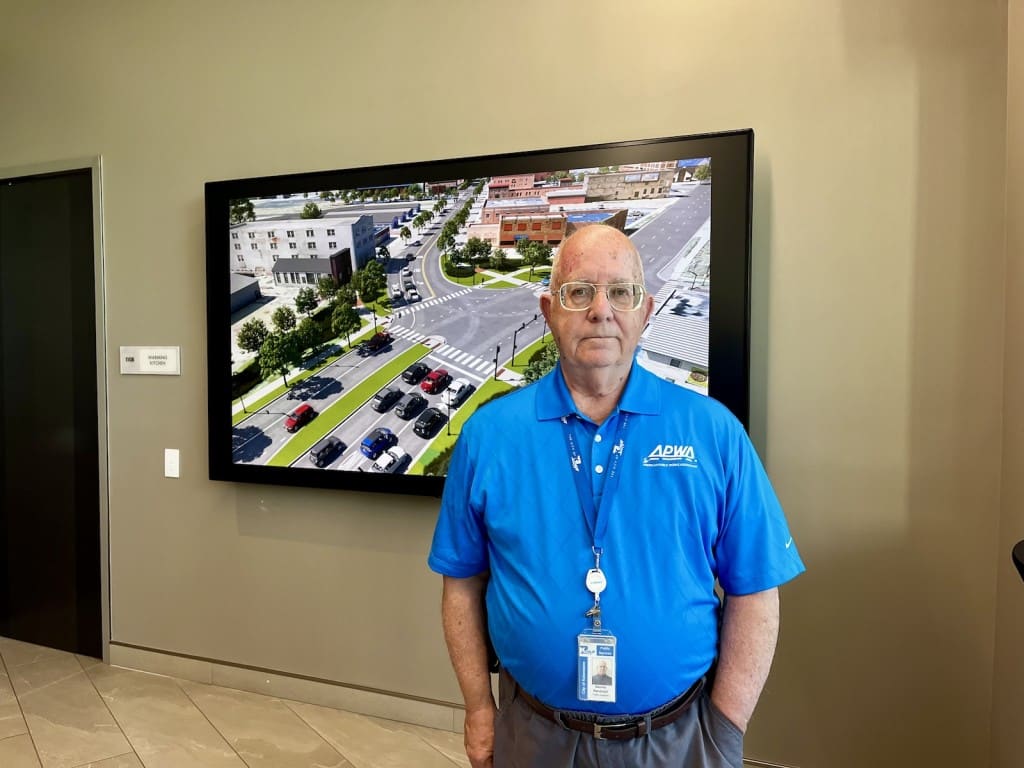
Randolph, who spent his career in traffic engineering, says the blame for dangerous roads is “between us” — those who design the streets and roads — “and the mechanical engineers who design cars,” he says.
“We have built streets for way too long that encourage people to drive faster either consciously or unconsciously,” Randolph says.
“And — you know, I got my little Toyota, but its speedometer goes to 150 MPH, and I’ll tell you the truth, I’ve never been on a road in the United States that was built for 150 MPH,” he adds.
Motor vehicles are designed for speed, for comfort and safety for those inside, and have been growing larger and heavier. New EVs tend to have powerful acceleration, and increased weight due to batteries — Bergstrom points out that the EV Hummer “weighs as much as an African elephant and goes from zero to 60 in four or five seconds.”
It’s much more difficult to see obstacles or people from inside today’s huge vehicles, Bergstrom says. They are safer in a collision for the driver than the sedans of the past, “but are very damaging at high speeds to any pedestrian that ends up being in their path.”
Bergstrom points out two local hit-and-runs, one killing a pedestrian in the Vine Neighborhood in March, and a motorcyclist on Gull Road in April.
“The person that has been in the motor vehicle has run, right?” he says. But “the pedestrian isn’t getting up and running.”
Then there was the near-100 MPH collision with a building in Downtown, in August of 2025. Those inside the vehicle survived, but “if pedestrians would’ve been present, it would’ve been a whole lot worse.”
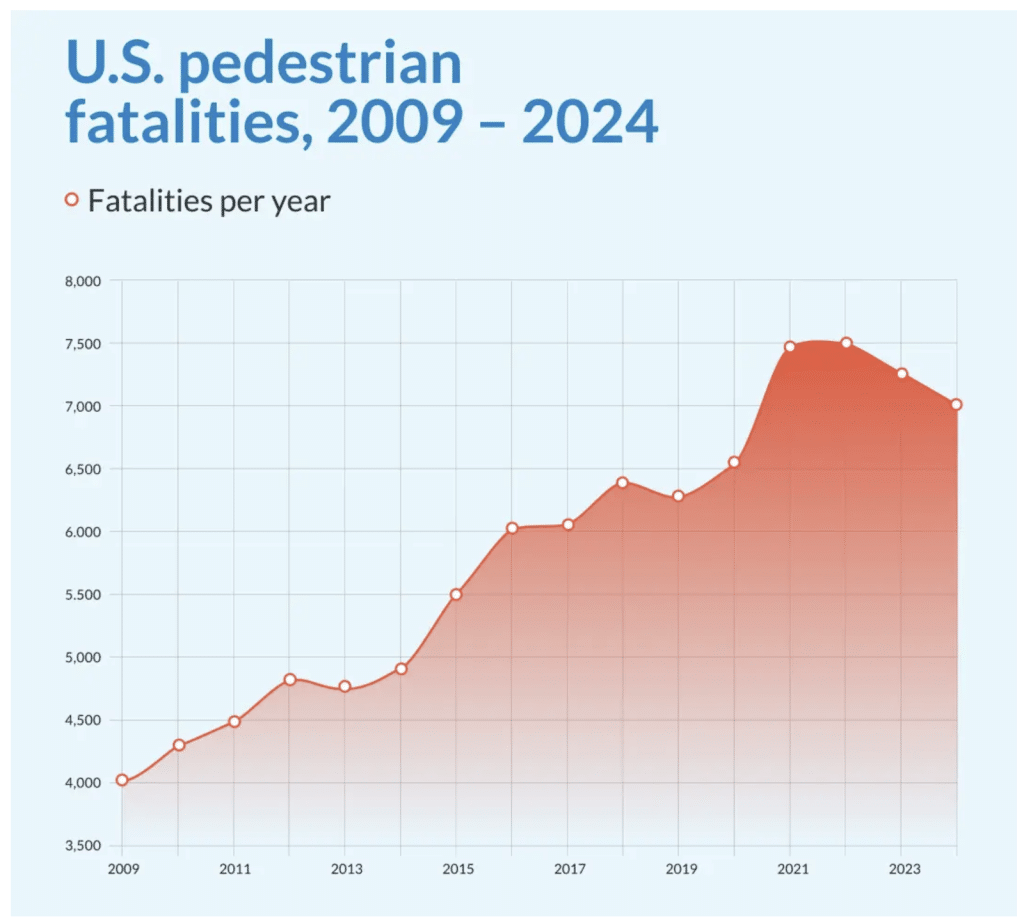
Bergstrom says that reports like “Dangerous by Design,” from Smart Growth America, show a rise in pedestrian deaths nationally, from around 4,000 in 2009 to nearly double, 7,500 in 2021. Deaths in the report crept down for the first time the following years, to 7,000 in 2024.
Vision Zero: Eliminating traffic deaths
There’s a limit to what traffic enforcement can do, and there’s no way for the City to redesign autos, so Kalamazoo has been following the “Safe System” approach, which is the evolution of Vision Zero, Bergstrom says.
Vision Zero is the goal of “eliminating traffic fatalities and severe injuries among all road users,” the Vision Zero Network site says.
The Safe System viewpoint is that society tends to think of safety as the responsibility of individual drivers, when we should be considering the responsibility of infrastructure design.
“The traditional roadway safety approach is built on an implicit assumption that people can be trained (encouraged, educated, and/or enforced) to behave safely all the time. The Safe System approach, on the other hand, recognizes that people will inevitably make mistakes,” the site says.
“The Safe System approach anticipates these inevitable mistakes by designing and managing systems…. And when a mistake does lead to a crash, a safe system is one that lessens severe impacts on the human body.”
This is why the City of Kalamazoo has been incorporating traffic calming methods into its old streets, and has designed coming Downtown changes with calming as a priority. “We want to mitigate the potential cost in both human life and property damage when it comes to those mistakes happening; that is the essence of it,” Bergstrom says.
Calming results
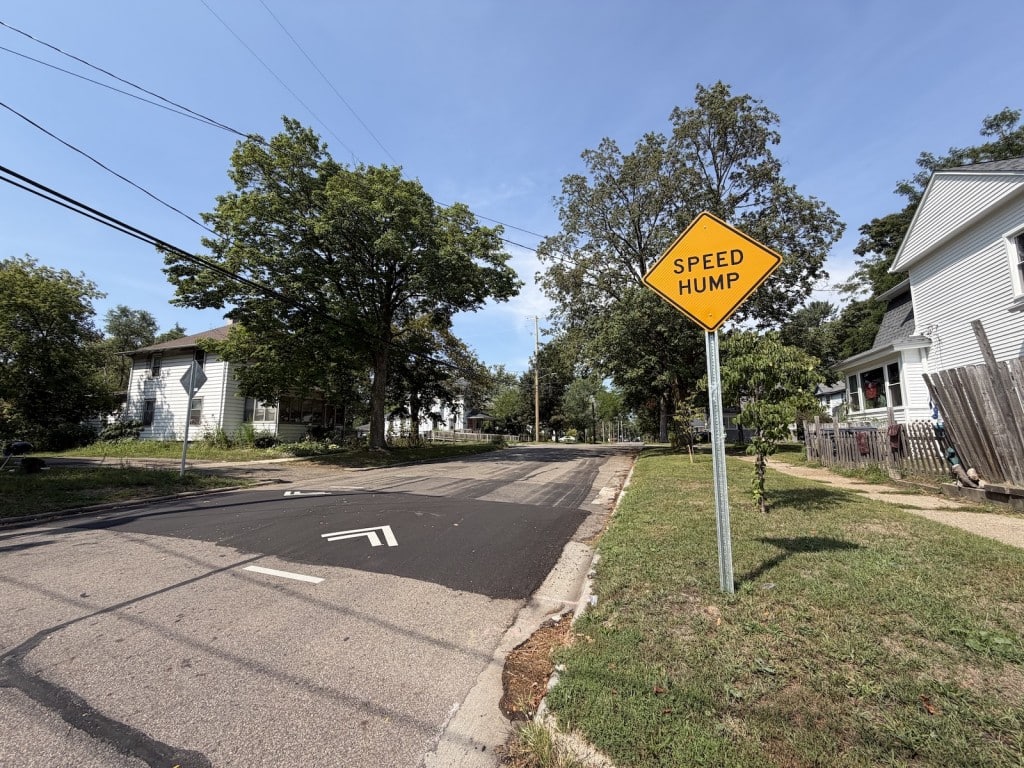
The City has seen road diets, cycle track pilots, speed bumps here, pedestrian islands there, all appear throughout the 2020s.
The intention is “to make it less comfortable” to speed, Randolph says.
There is work continuing this year on Portage Street and Cork Street to reduce multiple travel lanes to two lanes, and add a center turn lane and bike lanes.
Randolph says, “Four-lane roads are very unsafe.” When there’s space to pass, “drivers go faster, and on a four-lane street you get a lot of dodging and weaving.”
The same thinking is baked into the current Downtown two-way redesign. Kalamazoo Avenue and Michigan Avenue will have fewer lanes than they had in their one-way era. Kalamazoo Avenue and West Main Street’s connection with Douglas Avenue will lose their freeway-like on- and off-ramps and become traditional intersections.
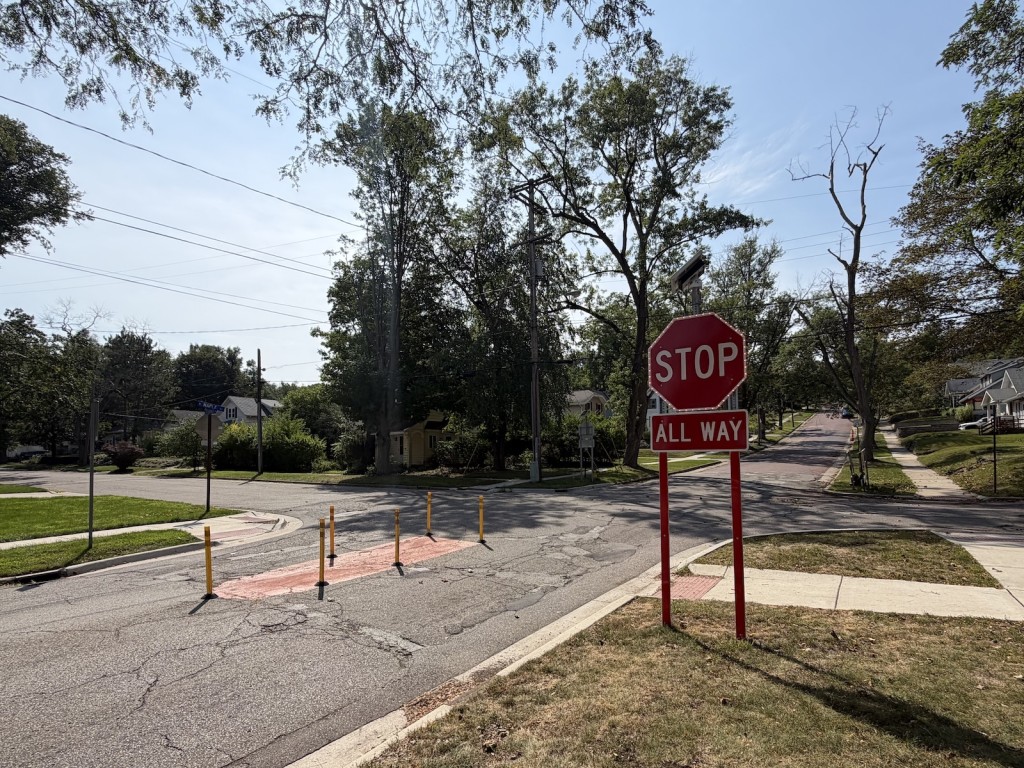
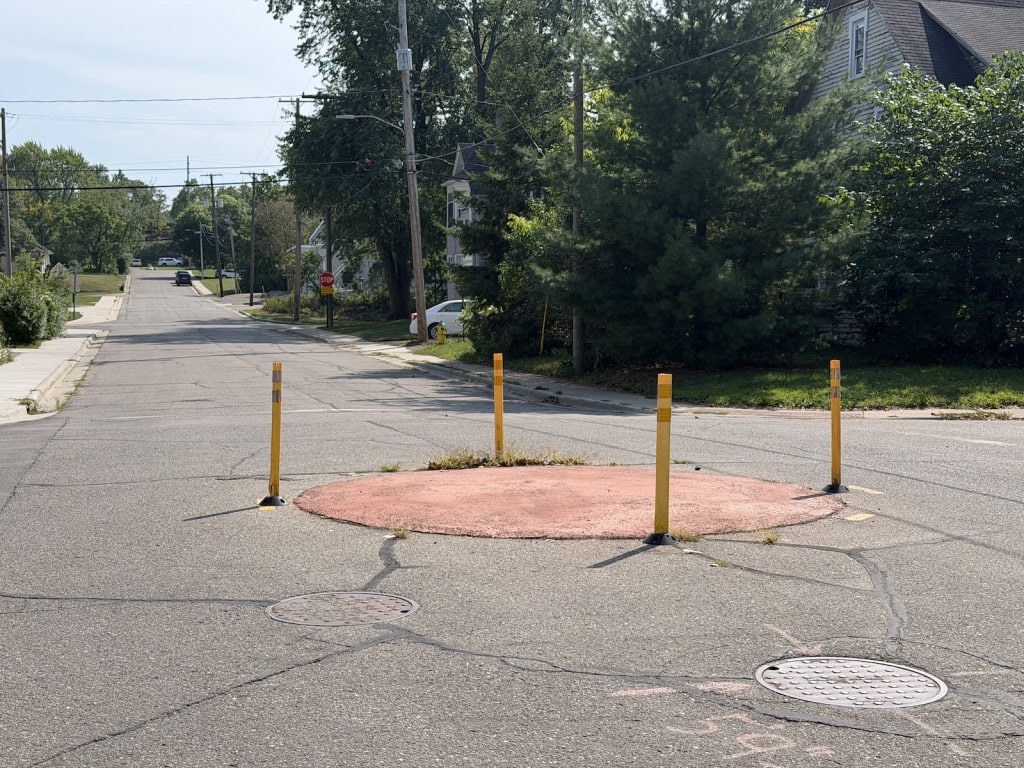
Street-side trees, bump-out curbs, pedestrian islands and bollards will also give the message to drivers to be a bit more careful than they would on a state highway. “Passive friction,” is how Bergstrom puts it. It all “helps slow people down and make that street safer.”
Has all the traffic calming made the City safer?
Randolph says yes. “We averaged around 3,100 crashes a year before COVID, and since then we’ve been able to drop that number every year, so it’s down around 25% right now from that 3,100.”
Randolph does say that because of increased snow last January and resulting collisions, there’s been a rise in crashes so far this year. “But when you take January away, again, we’ve got another year where the crashes have been going down in Kalamazoo.”
Collisions involving severe injuries have gone down, he says, but “fatals, because there’s so few, tend to be almost random in their nature, and that’s what makes them so difficult to eliminate.”
Crashes involving one or more fatalities spiked in 2023, with ten. There were five in 2024 and four in 2025, with a five-year average of 6.2 a year.
Changing culture
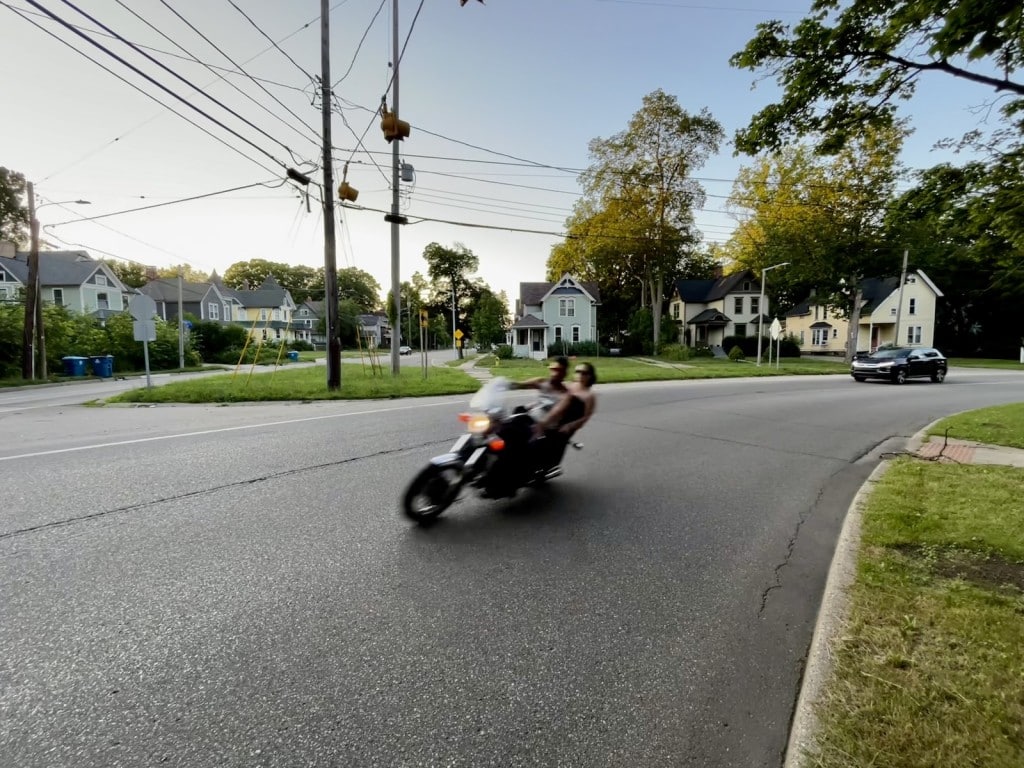
We show Randolph a photo from this summer, of a motorcycle going fast around the current Kalamazoo Avenue/Douglas Avenue curve.
Like a Rorschach test, it brings out a reaction in Randolph.
He zeroes in on how the rider and passenger on the bike aren’t wearing helmets.
“If you want to risk something, there’s better things to do than getting your brain smashed all over the pavement, you know. I just never quite understood that,” he says.
Randolph doesn’t understand why a motorcyclist wouldn’t wear a helmet, or why some drivers think they need to go above the speed limit.
Randolph acknowledges that some motorists don’t like the changes happening in the City streets.
“What we’re trying to do with traffic calming is to make the streets less friendly for people who want to drive fast or above the speed limit. In other words, “we’re designing the streets so that they match the speed limit,” he says.
“I think a lot of people know that, and that’s one reason they complain a bit about what we’re doing, because they’re all of a sudden put in a position where they don’t feel as comfortable going as fast as they feel like anymore. They know we’re constraining them and they don’t particularly care for that.”
Bergstrom notes that drivers in Kalamazoo aren’t familiar with some of the calming infrastructure. Cycle tracks, for example, are common in many urban streets around the U.S., but are new in Kalamazoo.
When the parking spaces and two-way cycle track configuration appeared on Michigan Avenue, “absent of information, that void fills in with speculation or anxieties that people have about something new,” Bergstrom says.
He points out that after a teen gets their license, from the age of 16 to their senior years, they don’t see any further driver’s education or tests on current laws.
If you got your license in, say, 1983, you might be ignorant of changes in crosswalk ordinances or of what to do around a person on a bike in a bike lane. (Full disclosure: Mark Wedel has been a driver since 1983.)
Bergstrom says, “I hope in the future, at least, the city can work to help educate residents through various means to better understand what some of these (changes) are.”
But some drivers just feel constrained by streets that make it difficult to go above the speed limit. They feel persecuted by cops pulling them over and issuing a ticket for going 10 over.
Is it our culture? Should we blame the movies, car commercials?
Is there something in Kalamazoo’s culture the City’s looking to change?
City Communications Manager Smith chimes in, “We are an automobile culture, and we have been for many decades. I think what we’re trying to do in the City is to change the mindset of the automobile culture and to make the city safer not just for motorists but also for pedestrians and bicyclists… that’s our main goal.”
Randolph says, “The real bottom line, I think, is balancing your freedom to do what you want, (with) do we want dead or mangled-up people — you know, is that the right trade-off?”
Controlling traffic, keeping drivers at or below the speed limit, “is about safety, and not having people killed or maimed,” Randolph says.
Author

Related Articles
Elbows up, hearts open: One Kalamazooan’s ride across a bridge built to connect
Kalamazooan Mark Wedel bikes the new Gordie Howe International Bridge, discovering history and connection as he pedals across the border from Detroit to Canada.
Short-term pain, long-term gain: Kalamazoo begins biggest Downtown street transformation in 60 Years
Construction is underway on Kalamazoo’s long-planned Streets for All project, with city leaders and downtown businesses acknowledging years of disruption while promoting the $100 million overhaul will create a safer, more accessible, and more vibrant downtown.
The road ahead: Everything you need to know about Downtown Kalamazoo’s two-way street conversion
Downtown Kalamazoo’s six-year, $50 million-plus two-way street conversion begins July 15, with phased construction leading to a calmer, more connected downtown by 2030.