How a small Quaker Meeting has helped shape Kalamazoo for nearly 80 years
In Kalamazoo’s Douglas neighborhood, the Kalamazoo Friends Meeting blends silent Quaker worship with decades of local activism, from peace advocacy to community care at Adda Dilts Peace Park.
Editor’s Note: Voices of Faith is a series that amplifies the insights of local faith leaders and organizations — voices too often missing from conversations about community development, city planning, and civic life. The series explores how these leaders address pressing issues such as housing, safety, equity, mental health, climate, and youth engagement through love, faith, and action. All photos were taken by Matthew Miller unless otherwise specified.
“True silence is the rest of the mind, and is to the spirit what sleep is to the body, nourishment and refreshment.” — William Penn
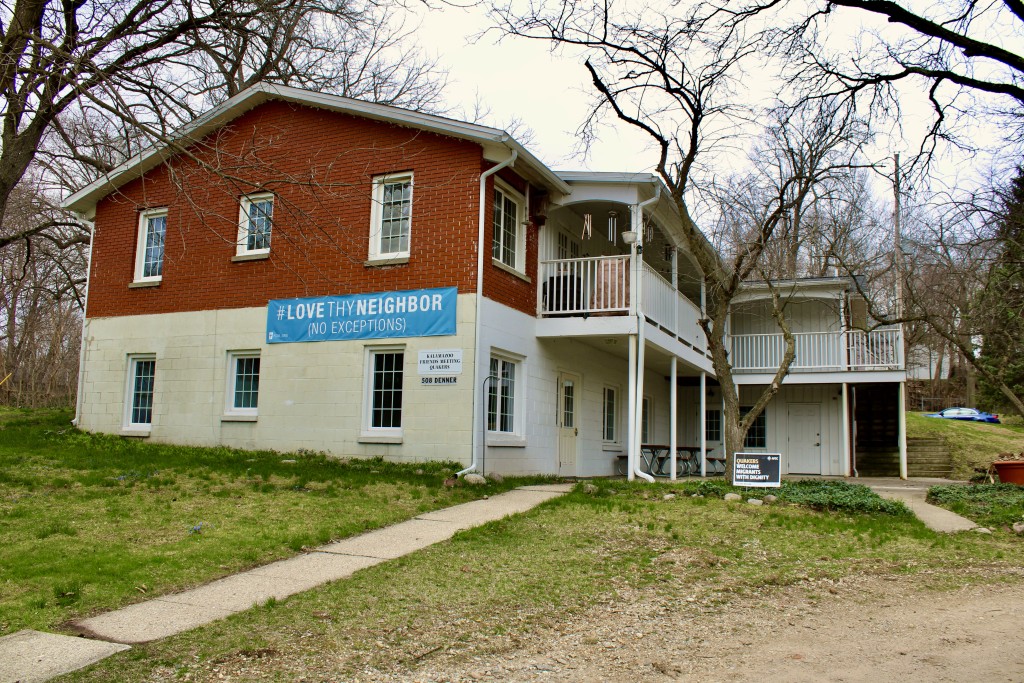
KALAMAZOO, MI — On a quiet Sunday morning in Kalamazoo’s Douglas neighborhood, a small group gathers inside a modest building beside Adda Dilts Peace Park. There is no music, no sermon, and for long stretches, no sound at all.
Sunlight filters through tall windows onto a circle of simple chairs. Some people sit with their hands folded in their laps. Others close their eyes. Outside, early spring birds break the silence.
This is the Kalamazoo Friends Meeting, a Quaker community that has practiced silent worship and social activism in the city for nearly 80 years.
Though small in number, the group has maintained an outsized presence in Kalamazoo — supporting conscientious objectors during the Vietnam War, welcoming refugees, advocating for LGBTQ+ rights decades before legalization, and continuing to organize around war, incarceration, and immigration today. Their approach is rooted in a centuries-old belief that every person carries an “inner light,” and that faith is best expressed not through hierarchy or ritual, but through action.
The Religious Society of Friends — commonly known as Quakers — emerged in 17th-century England under the leadership of George Fox, who rejected formal church authority and preached that individuals could experience God directly. That belief in direct access to the divine led Quakers to embrace pacifism, equality, and simplicity.
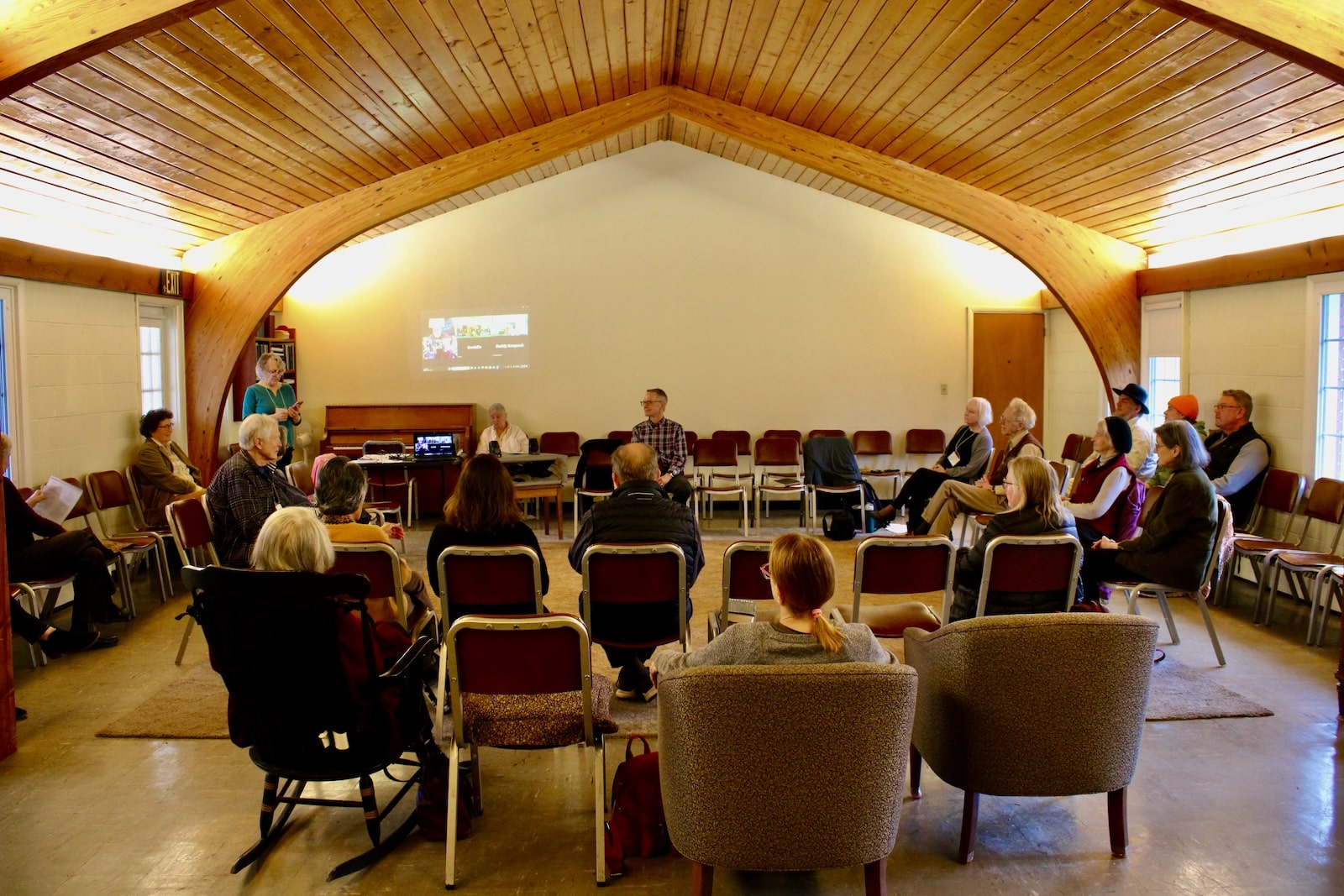
“When I first came to Quakerism,” says Kalamazoo Friend Joe Ossmann, “it was clear to me very early on that not everyone was expected to believe the same way, but that everyone in the room had a commitment to living their faith. We take our faith very seriously in our lives, and there is mutual support for each person’s expression.”
In America, Quakers were early advocates for abolition and women’s rights, and their relief work during and after the World Wars earned them the Nobel Peace Prize in 1947. Today, their numbers remain small — about 55,000 in the United States — but their influence has often extended far beyond their size.
In Kalamazoo, that legacy took root in 1946, when six residents gathered for what may have been the city’s first Friends Meeting. The group grew steadily, meeting first in homes and borrowed church spaces before establishing a permanent meeting house near what is now Adda Dilts Peace Park.
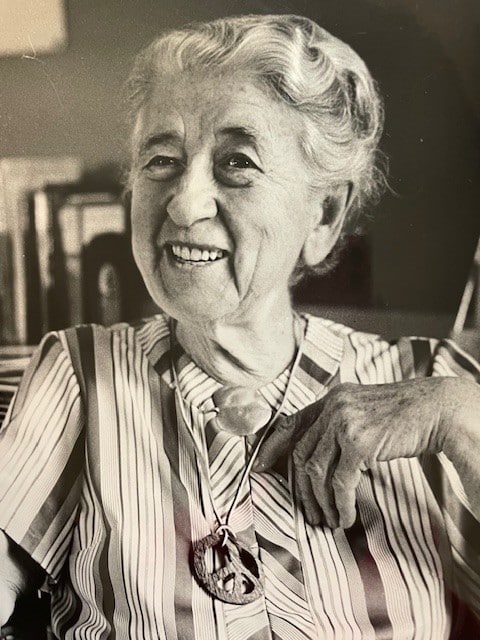
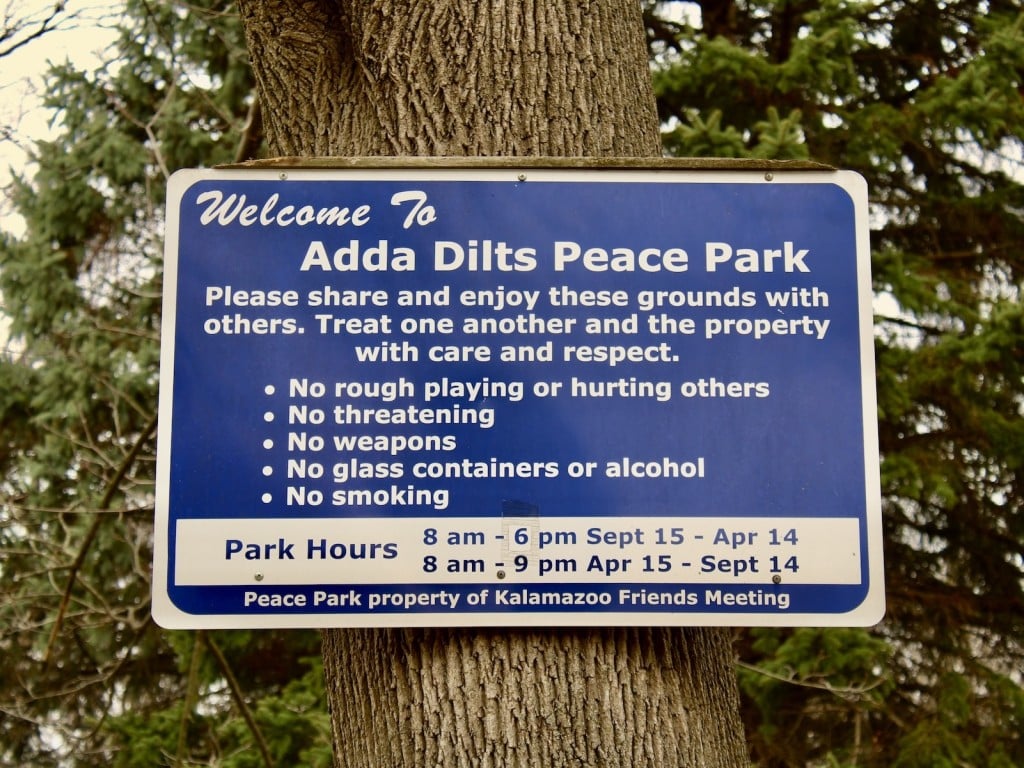
The land itself came with a story. Adda Dilts, a key early supporter, donated the funds to help build the meeting house and later lived in a small apartment inside the building. When asked if she minded living next to a cemetery, she reportedly replied that it looked to her like “a nice shady park.”
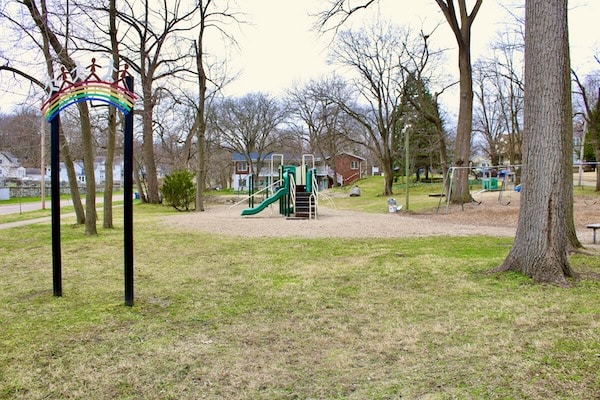
That sense of calm, paired with a commitment to action, would come to define the community.
During the Vietnam War, Kalamazoo Friends publicly opposed the conflict and supported young men seeking conscientious objector status. The meeting house became a place for counseling, spiritual guidance, and organizing. Members traveled to protests in Washington, D.C., and demonstrated at a chemical plant in Indiana producing weapons used in the war.
As war raged in Vietnam in the 1960s, Kalamazoo Friends Meeting’s Peace Committee shared publicly, “the traditional Quaker peace testimony has as its basis the belief that to live the Christian life is to live the life that takes away the occasion for war and violence…the testimony is rooted in the belief of the dignity and infinite worth of each individual.”
In the decades that followed, the group continued to take public stances. They helped resettle refugee families, supported school integration efforts, and conducted same-sex marriage ceremonies more than 20 years before such unions were legally recognized nationwide.
“Quakers believe the light of God is in everyone,” one member told the Kalamazoo Gazette in the early 1990s. “Gays and lesbians are people who deserve the same respect.”
That commitment to equality and peace continues to shape the meeting today. Members remain active in local organizations, including advocacy groups focused on nonviolence, like Kalamazoo Nonviolent Opponents of War (KNOW), environmental issues with Hope for Creation, and LGBTQ+ inclusion as members of Kalamazoo’s Faith Alliance. A small but dedicated advocacy team regularly contacts elected officials, writes letters, and organizes around national policy concerns—from military spending to immigration enforcement.
But on Sunday mornings, the work begins in stillness.
In silence grows the ‘inner light’
Entering the Friends Meeting House, the simplicity is immediate.
The room is spare — no altar, no cross, no obvious markers of a traditional Christian space. A few posters hang on otherwise bare walls. Morning light filters through wide windows, settling across a wood-paneled ceiling and worn brown carpet. The building carries the quiet weight of age, but little ornament.
That openness is intentional.
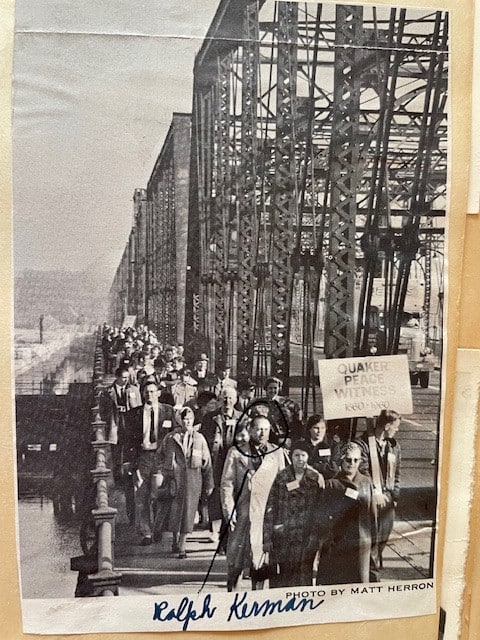
Part of why the space is open for religious interpretation is surely intentional. As carried down from their earliest Quaker Friends, they believe the Divine presence can take different forms” for everyone within themselves. “Everyone has access to the divine spirit, without a mediator,” Ossmann says. “You don’t need a priest, we don’t need a book. Yet the teachings live on.”
Quakerism, formally known as the Religious Society of Friends, is rooted in Christian teachings, but individual interpretation varies. “It depends on who you ask,” says Carol Meyer-Niedzwiecki when asked about the role of Jesus in the meeting today.
“There are Jewish Quakers and Buddhist Quakers,” says Ossmann.
That mix of shared values and individual belief carries into how the group gathers each week.
Sunday meetings begin at 9:30 a.m. with an hour of discussion, often focused on social or political issues. On this day, about a dozen attendees met to consider which priorities they would recommend to the Friends Committee on National Legislation, a national Quaker advocacy group that works on federal policy.
The conversation, described by members as a “spirit-led exploration,” centers on shaping recommendations for the organization’s next legislative agenda. While the setting is religious, the tone often resembles a policy discussion.
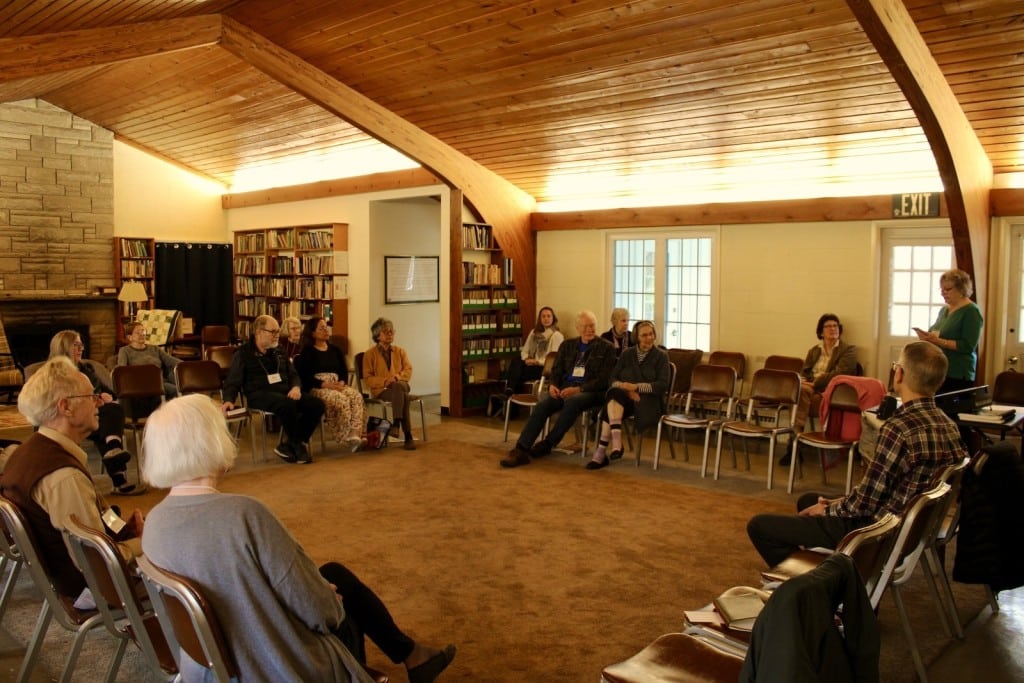
A member joining remotely appears on a projected screen and jokes, “No one is talking,” drawing laughter from the room. The silence, a central part of Quaker worship, would come later.
With no formal clergy or hierarchy, the discussion is loosely guided by Raelyn Joyce, a longtime member. She asks participants to read aloud from a list of current legislative priorities before breaking into small groups to identify key concerns for the next congressional session.
Before the groups begin, Joyce offered a passage from the New Testament (Philippians 2:3–4), encouraging humility and attention to others’ needs.
In one group, members Mark Donovan, Joseph Mills, and Lynn Paxton-Romine speak candidly about the challenges of narrowing down priorities.
“These keep coming up,” Paxton-Romine says. “They are all interconnected.”
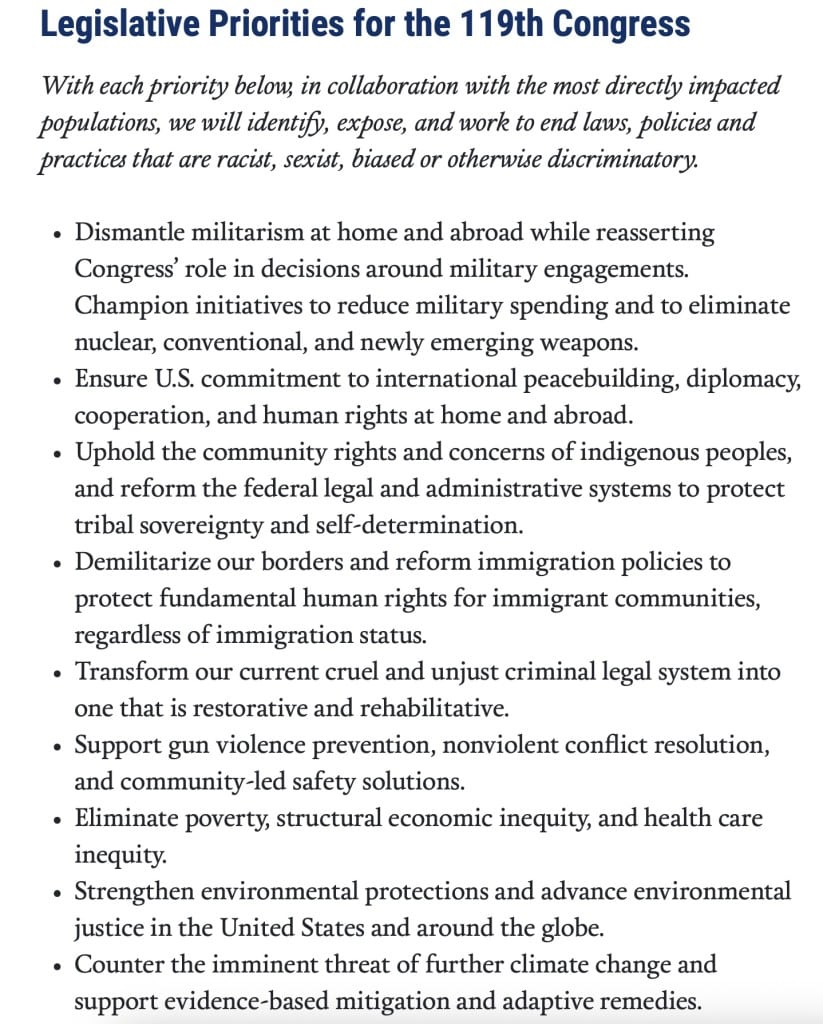
Mills points to incarceration as a central concern, citing what he described as inhumane practices within the system. Others noted how quickly new issues emerge, including the rapid rise of artificial intelligence as a policy concern.
“I resent that I have five emergencies from this,” Paxton-Romine adds. “That more are being created to distract us.”
Donovan acknowledges the scale of the issues. “You have to nibble around the edges,” he says, “hoping it will make change in the long haul.”
The group ultimately identified several priorities, including criminal justice reform, environmental protection, economic inequality, and reducing military spending.
When the full group reconvenes, the conversation groups share similar themes. Joyce describes the exercise as the beginning of an ongoing process that would inform what the meeting shares with national Quaker advocates.
Soon after, the chairs shift slightly, conversations taper off, and the room settles.
Time for worship
By now, the room is beginning to fill up, and around 25 people, including Zoom Friends, are in attendance. Shuffling to seats is done with quiet ease as folks settle into seats that seemed habitually assigned through regular use.
There are two styles of Quaker Meeting worship, programmed and unprogrammed. As the name suggests, programmed meetings include a structure of music, readings, and a sermon. Unprogrammed is a worship style that is based on silence, where any service attendee can stand up at any time as they feel moved by God to share scripture, a religious insight, or even to sing. The Kalamazoo Friends choose the latter.
Attendees sit together in quiet, waiting. Anyone may speak if they feel moved to do so, but no one is required.
The silence is not empty. It is attentive.
Minutes pass. The sounds of the building — chairs creaking, a cough, feet shuffling — become part of the experience. Outside, birds grow louder.
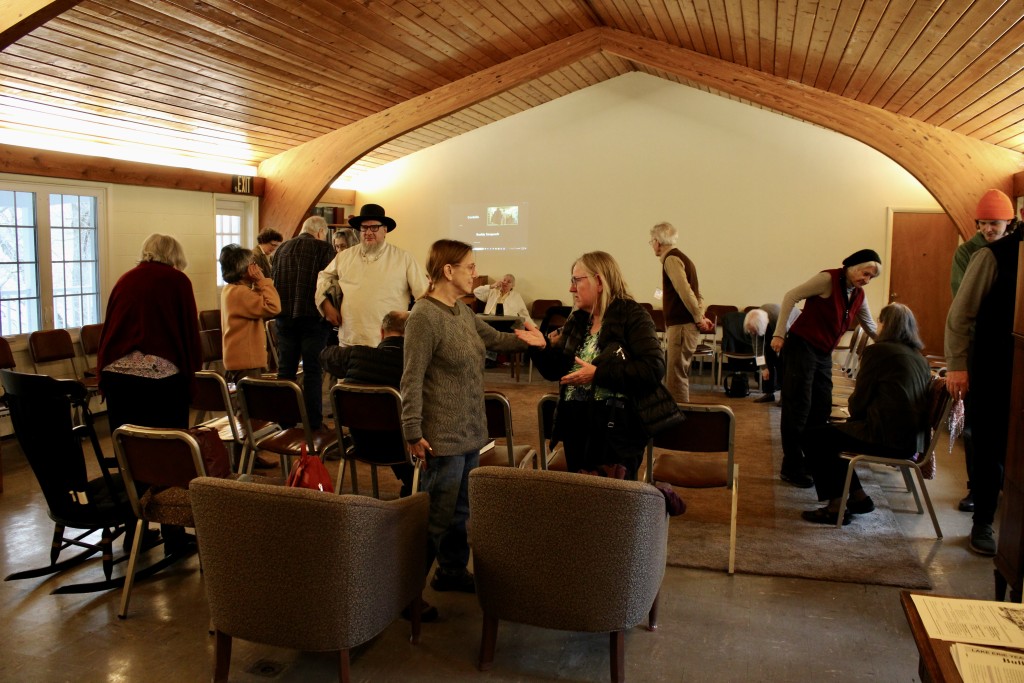
After about 15 minutes, one person stands and reads a passage from scripture. They sit down. The room returns to stillness.
Later, another attendee rises and speaks about the idea of the Antichrist — not as a single figure, but as the human tendency to seek salvation through political systems or ideologies. True peace, they suggest, cannot come from those sources alone.
The message is brief. Again, silence.
A third speaker reflects on a recent moment of hypocrisy within a Quaker gathering, where a conversation about loving one’s neighbor gave way to judgment and frustration. The speaker calls it a reminder that self-examination is ongoing work.
Near the end of the hour, one final voice offers a thought: if policymakers could truly understand the lives of those affected by war, perhaps their decisions would change.
Then, gradually, the silence lifts.
The meeting closes with a time for sharing personal joys and concerns. A neighbor who lost a home in a fire. A member dealing with chronic pain. A farmer struggling to balance finances with the desire to feed those in need. A child facing deportation.
Announcements follow: an upcoming letter-writing effort to elected officials, a call for continued advocacy, and an invitation to gather downstairs for coffee.
Finally, as is customary, attendees turn to one another and shake hands.
Blending faiths: The light-giving life of a “Quak-tholic’
For many, the meeting house is not just a place of worship, but a center of community life. That is especially true for Cordelia Greer, who has lived in a small apartment inside the building for nearly 30 years, continuing the legacy of Adda Dilts.
Greer grew up in Kentucky and was raised Catholic, but her life has long been shaped by service. After college, she worked with youth in poverty programs across the South, witnessing firsthand the effects of inequality.
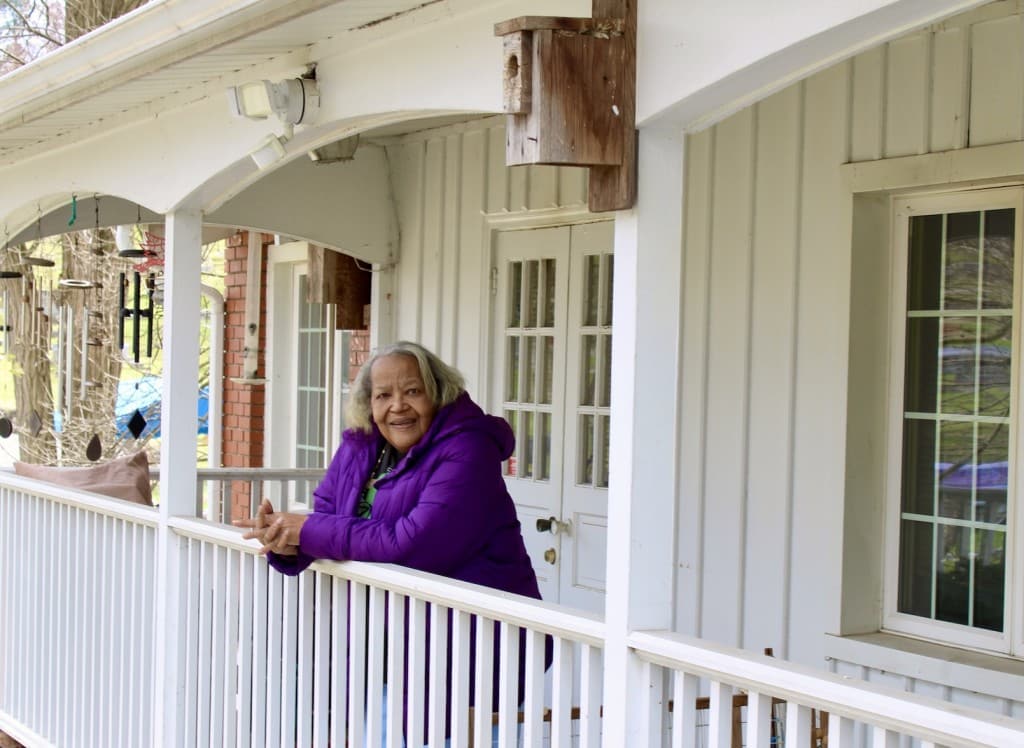
“I learned how to be humble and accepting,” she recalls. “You’d be invited into someone’s home, and there might only be a bowl of beans to share.”
She later volunteered with early Habitat for Humanity efforts, including work abroad, before eventually moving to Michigan. While studying at Western Michigan University, she connected with the Kalamazoo Friends Meeting and found a community that aligned with her values.
She now describes herself, with a smile, as “Quak-tholic” — attending both Quaker meetings and Catholic Mass.
Her role at the meeting house extends far beyond residency. As a caretaker of the adjacent park, she has spent decades building relationships with neighborhood families, particularly children.
When she first arrived, she says, the park was often a site of drug activity. Over time, she helped organize a group of contracted workers — known as Peace Keepers — to create a safer, more welcoming environment. When Peace Keepers aren’t around, it’s Cordelia who maintains a watchful eye.
Today, the space is used by families and children. The park is named after Adda Dilts, the first resident of the Kalamazoo Friends Meeting House, who lived in the building for over a decade until 1971. Greer remains a constant presence.
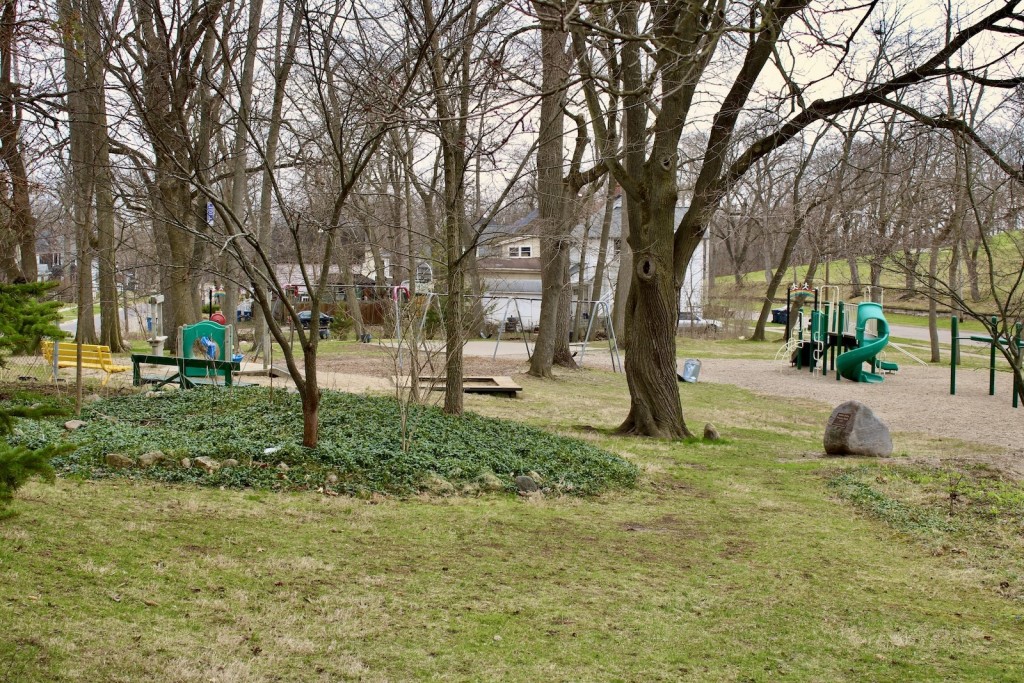
“My door is always open,” she says. “Even when I don’t want it to be. I don’t turn anyone away, even if I am ready to go to bed.”
Kids from the neighborhood stop by at all hours — sometimes late at night — looking for a quiet place away from difficult situations at home. Greer doesn’t turn them away.
“I love doing that,” she says. “Sometimes I feel it when I want to sit and read my book, but it’s okay.”
She also helps organize programs like a monthly community meal and supports local students with tutoring and school supplies. But it is the day-to-day interactions that seem to matter most.
“I want to be a beacon for whoever,” she says.
Back inside the meeting house, the chairs sit empty after the service, the quiet lingering a little longer before the sounds of conversation and movement take over downstairs.
For a group rooted in silence, the Kalamazoo Friends have never been entirely still. From their early days to the present, their faith has been expressed as much through public action as private reflection.
“We’re a meeting of friends,” says Meyer-Niedzwiecki. “We hope some of that energy reaches the community.”
In a small building beside a neighborhood park, that effort continues — quietly, but with lasting impact.
Author
Matthew Miller is a social worker and freelance writer who started with Second Wave in 2025. He is the lead writer for the Voices of Faith series and resides in Kalamazoo.
Related Articles
Baseball great Darryl Strawberry to share his faith journey at Battle Creek Community Prayer Breakfast
Former MLB star Darryl Strawberry will share his powerful journey from fame and addiction to faith and redemption at the 2026 Battle Creek Community Prayer Breakfast, offering a message of hope and healing to the community.
Sisters leading a revolution of love — for the earth, the elderly, and every ‘dear neighbor’
Once nearly a thousand strong, the Nazareth Sisters of St. Joseph helped shape Kalamazoo’s identity. Today, even as their congregation shrinks, their commitment to serving the “dear neighbor” is only growing deeper.