
From ancestral trails to two-way roads: How Kalamazoo streets keep changing with the times
Kalamazoo’s shift from one-way to two-way streets reflects centuries of evolving transportation as the city reimagines a more walkable, people-centered downtown.
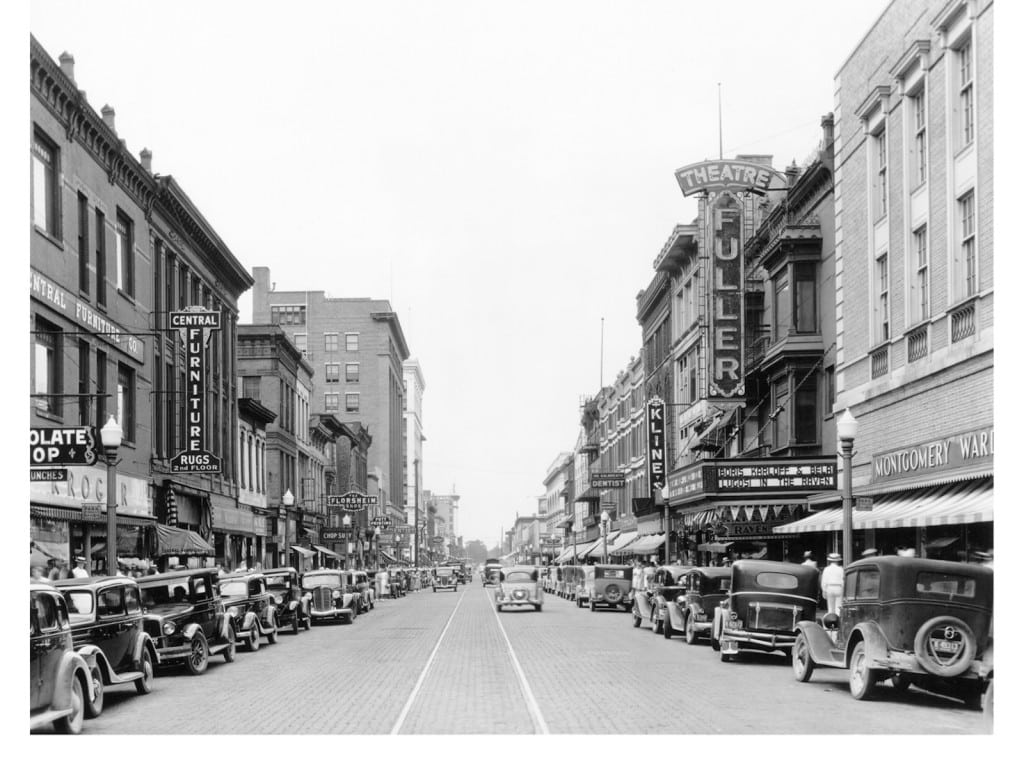
Editor’s Note: Photos are courtesy of Kalamazoo Public Library/City of Kalamazoo, unless noted.
KALAMAZOO, MI — Sometime quite a while ago — as the glaciers were thawing, 13 millennia ago if not earlier — people came to Southwest Michigan.
They wore trails through the wilderness from Lake Michigan heading east. First on foot, then on horseback.
Others came, turning the trails into roads. They settled, built towns and factories.
Then came streetcars, automobiles, and suddenly we have a gallon of gas going up past $4 and traffic calming and bike lanes and….
History teaches that change is unavoidable. The City of Kalamazoo has seen a lot of change.
New ideas have come and gone about transportation to, through, and inside Downtown.
City leaders once thought that personal flying machines might become the norm. The Kalamazoo Mall was part of a plan to pedestrianize all of downtown, a plan dropped because it would’ve turned some neighborhoods into parking lots.
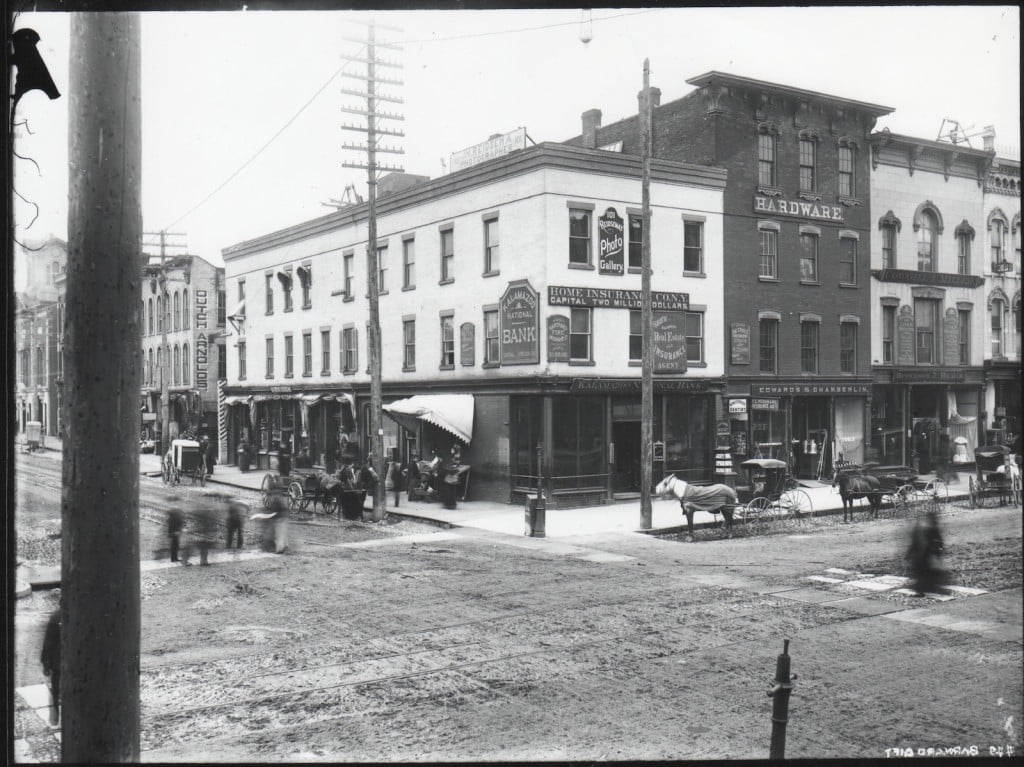
Now we face a change where one-way roads will be converted to two-way. The City will be transformed into a place where we can “live, work, and play,” but that means modifying the car-dominant infrastructure we’ve gotten accustomed to since the 1960s.
To put the current changes in perspective, Second Wave talked to some Kalamazoo historians about our streets and roads, why they are the way they are, and the forces that motivated change.
From Native trails to the City’s 1927 master plan
“How much time do you have?” Lynn Houghton, regional history curator at Western Michigan University libraries, answers when asked for a summary of Kalamazoo streets’ history.
One might think to start “when Titus Bronson came here in 1829,” she says. But there were roads through town long before the area had a town.
West Main, West Michigan, Stadium Drive, M-96 heading east, “a lot of that began with the Native Americans who lived here,” Houghton says.
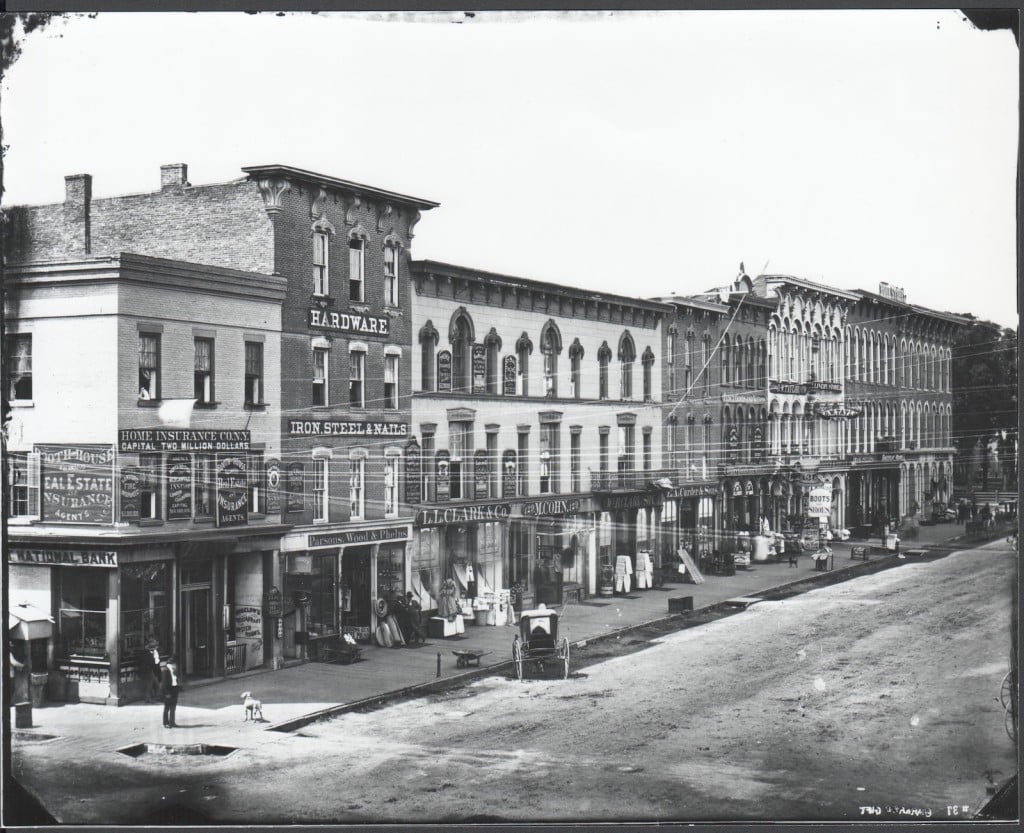
“When you look at our early roads, they’re early because you’re looking at either the impact of the Native Americans, or the impact of the territory of Michigan.”
Where WMU students now walk their pedestrianized section of West Michigan, pack horses and oxen trod the Territorial Road that stretched from Chicago to Detroit.
In 1830, just after Bronson parked by little Arcadia Creek and built his shack, the road underwent improvements — a bumpy corduroy surface, which was cut logs laid over the dirt, to hold the weight of heavy wagons and stagecoaches.
As land speculators, merchants, and settlers came, political/commercial fights sprang up over what became Kalamazoo streets.
When the Village of Bronson and Comstock tussled to become the new county seat, Houghton says, documents of the time show the honor went to what became Kalamazoo because of the regional roads that ran through it.
“I love the story of Kalamazoo Avenue,” she says. The Village had its wide Main Street (now West Michigan and East Michigan) established. But there were city founders who pushed the creation of Kalamazoo Avenue as the city’s main street. They made it wider than Main, hoping to make it the center of commerce. “So many businesses already were on Main Street, I don’t think that they were gonna move at all.”
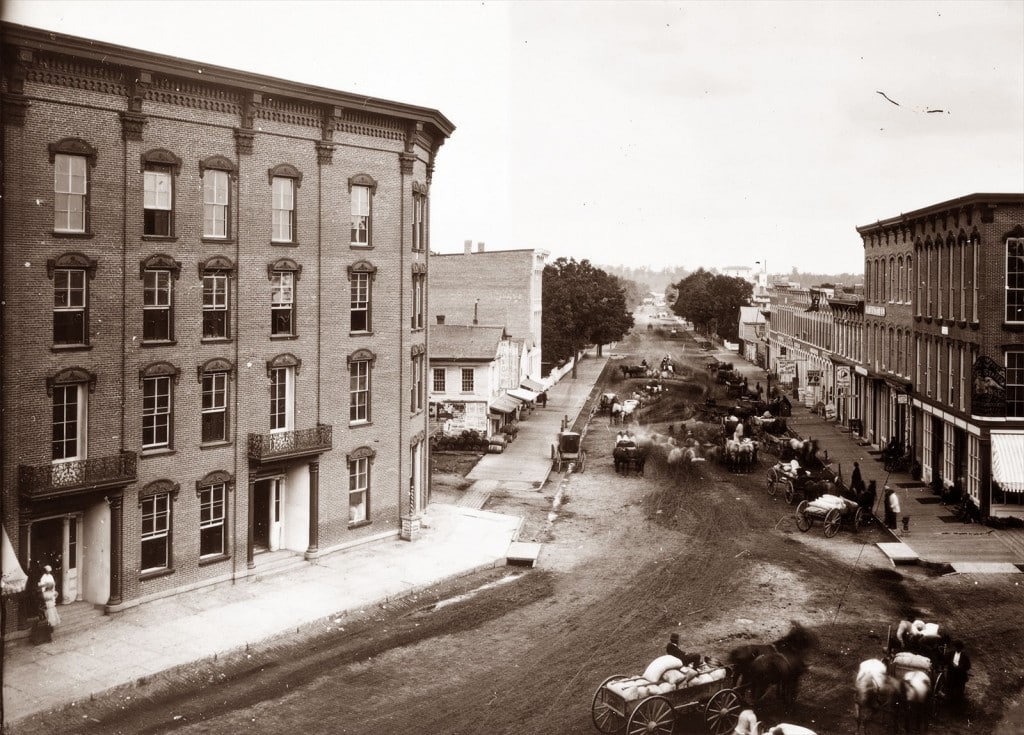
Another Native trail was where Portage Street/Portage Road is now. But not all of Portage is where the original trail was. The city founders and the Burdick Brothers made sure it bent into the curve of what’s now West and East Michigan. It led travelers directly to the doors of the Burdick’s new Kalamazoo House Hotel.
“That gives you an idea how sometimes individuals would develop streets to bring business to their area,” Houghton says with a laugh.
“It’s a fascinating topic,” she says, “the importance of something that we use every day in our growth, in our development… and the difference that it would have meant for Bronson/Kalamazoo if they didn’t have those pathways, that then become the roads that became our streets, as far as our growth.”
Houghton says, “We owe a lot to them, even though sometimes we curse at them because they’re one way going this way, one way going that way.”
Paving the way
Then came horse-drawn streetcars, brick roads, and electric streetcars. The pace of change quickened. As the trollies were taking workers to and from the suburb of Edison to their jobs, the Model T made it possible for many families to own a car. No longer did they have to rely on where the trolley tracks went.
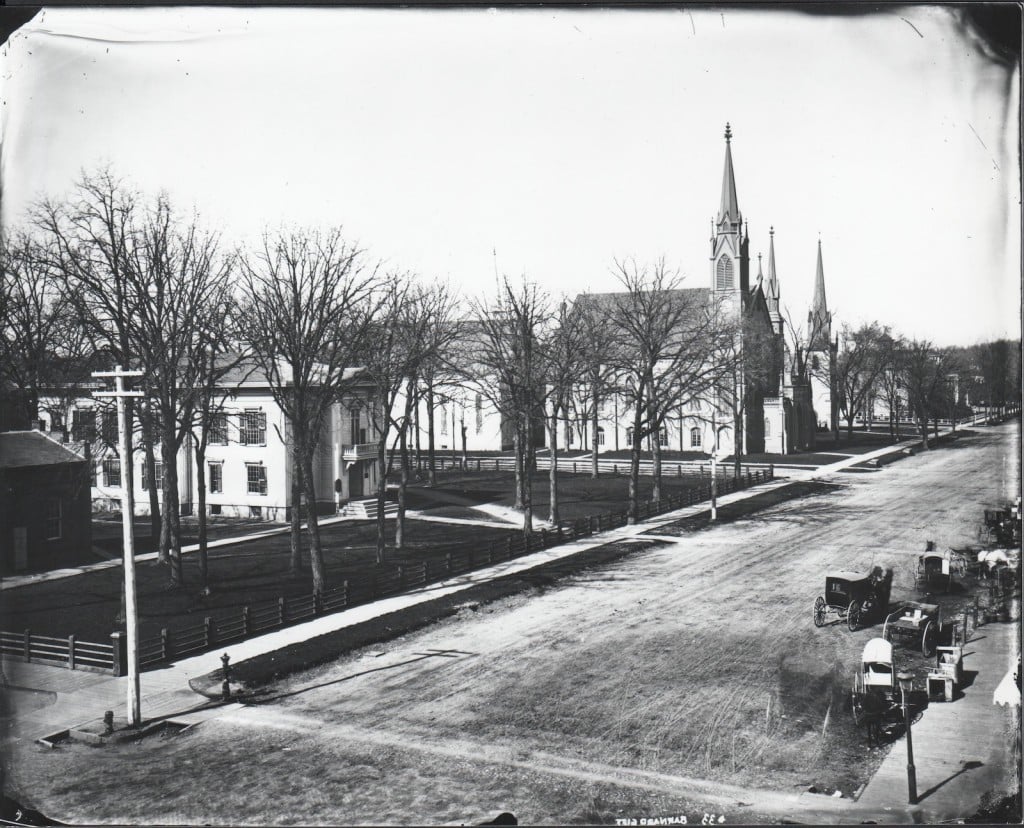
In the early 20th Century, there was explosive growth in Kalamazoo and rapid changes to modes of transportation. The City had to get with the times and try to plan for a very different future.
Things were vastly different by the 1920s. Sharon Ferraro, retired historic preservation coordinator and “semi-official historian” for the City of Kalamazoo, says.
“Our first master plan in 1927 really paid some real attention to the streets because they felt they had been kind of blindsided by how quickly automobiles had taken over, and how quickly the streetcar system became more and more expensive to keep going.”
The 1927 plan also looked to a future when we’d all have personal airplanes.
Today, cars; tomorrow, flying machines, was the thought at the time. In the late ’20s, vertical takeoff aircraft, pre-helicopter, were being developed, so the master plan had “takeoff and landing sites in four quadrants of the city,” plus “one on top of city hall,” Ferraro says.
The mini-choppers never came, but more cars did. In the late 1930s the concept of the “parkway” arrived, a national trend that created roads such as Crosstown Parkway, meant to allow traffic to flow around a city and quickly through the traditional grid of neighborhood streets and intersections.
Kalamazoo 1980
The City grew. Neighborhoods that were the suburbs of the City became official parts of the City — Milwood, for example, voted to be annexed at the end of World War II, Ferraro points out. New shopping centers like the still-operational Cork Lane sprouted up on cheap land. The ease of privately-owned car travel caused sprawl into Portage and elsewhere.
“So you’re getting this suburbanization. We’re starting to get grocery stores and drugstores moving out of the downtown, and they’re moving to these small shopping centers, ” Ferraro says.
People used to be able to walk “to get their food and their day-to-day necessities” in their neighborhoods, she says, but that became difficult in the City because stores were moving out.
In the late 1950s, the City sought to keep shoppers downtown by hiring pioneering mall architect Victor Gruen.
He gave them “Kalamazoo 1980,” a plan that would turn much of the downtown into a car-free pedestrian zone, surrounded by a ring road and many parking lots. “It was like the Crossroads Mall, a giant donut of parking surrounding commercial retail buildings. The whole downtown was supposed to look like that,’ Ferraro says.
The City cut its plan down to a two-block pedestrian mall, the first of its kind in the nation. The Kalamazoo Mall opened in 1959. It would expand to three blocks. In 1998, a narrow one-way street opened two of those blocks to traffic.
In the 1950s-1960s, Downtown was the place to go for gifts, clothes, and other non-day-to-day shopping, Ferraro says.
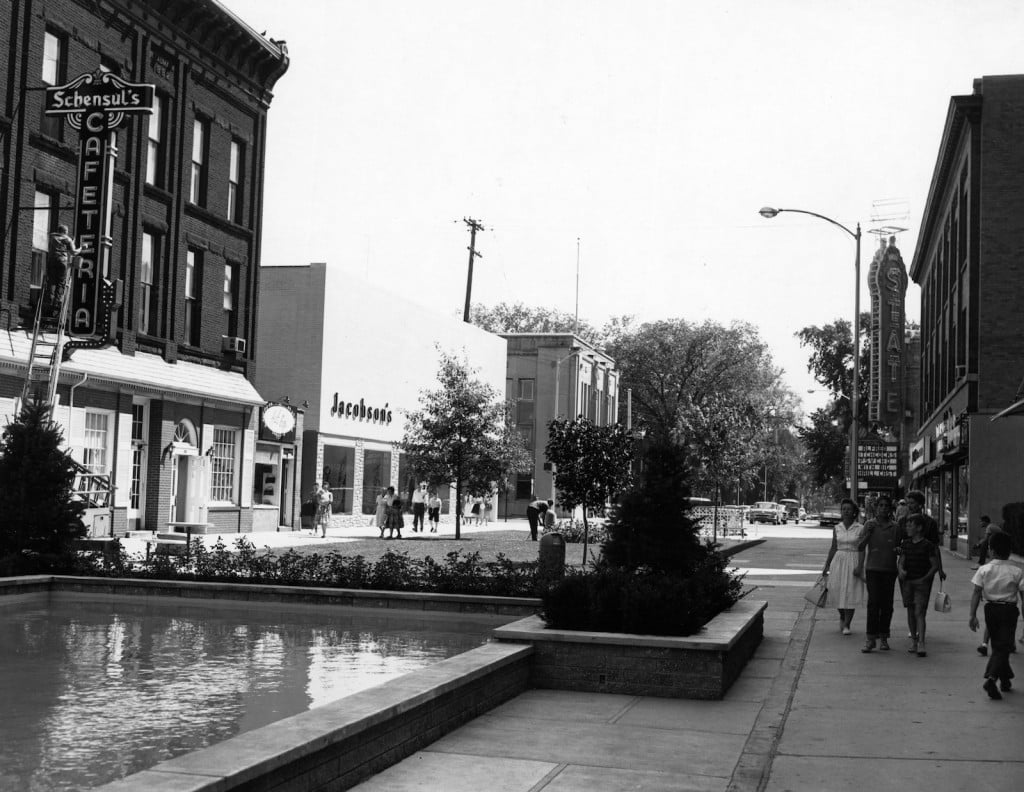
The Kalamazoo Mall did bring in shoppers, for a time. “I’d say it worked for about ten years,” she says.
Then the new indoor malls sprang up in Portage and west of the City on West Main. Huge parking lots were provided for all the customers who could drive to them. The malls provided the experience of walking and shopping in a pedestrianized Downtown, except with climate control. The old department stores, JCPenney, Sears, and Gilmore’s, left the downtown eventually, and the City was looking for new solutions.
Our one-way past — 1950s onward
The ’50s-’60s was the era of the national “urban renewal” movement, which called for, “just tear it all down and then it’ll be built up fresh and new,” Ferraro says. “Thank goodness we (Kalamazoo) didn’t do that exactly.”
What Kalamazoo did do was convert many of its streets to one-way.
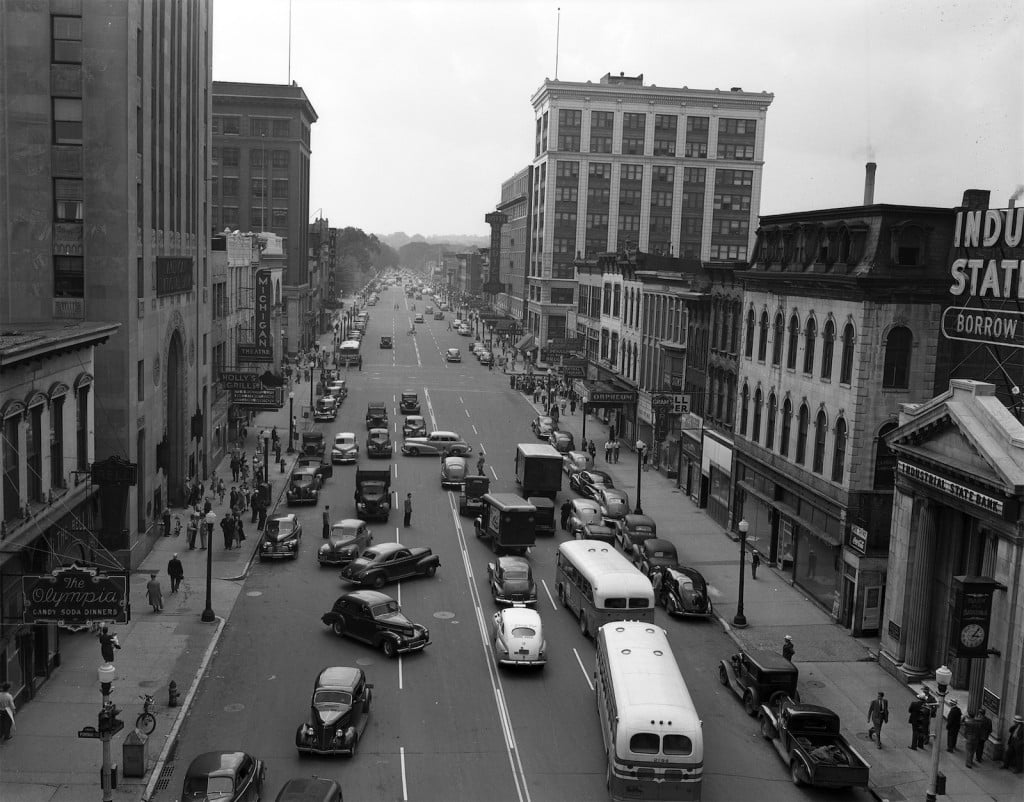
Houghton says that it started in the 1950s. “They were following what was popular at that time. And, as Sharon Ferraro said, you know, it was to get people in and out of Downtown as quickly as they could.”
Ferraro says people were avoiding Downtown and were willing to drive to the new malls even if it was a further drive.
Also, “kind of overlaid over the whole thing, there was a certain amount of not-spoken-about white flight.” There was “that feeling that, you know, ‘we’ve got all these non-white people showing up in the city’…. I have heard that there were some Christian ministers who were, from the pulpit, saying things like ‘get out now while your property values are still good’ in the late ’60s and early ’70s.”
Within this context, there was a new push for better traffic flow. This culminated in the mid-’60s, when Michigan Avenue/East Main and Kalamazoo Avenue were made one-way, multi-lane segments of MDOT’s state highway system.
Did the City officials want traffic to travel quickly through Downtown?
At the time, “they said, ‘Well, let’s do something new with the Downtown. We’ve done this (Kalamazoo) Mall thing, let’s see if we can make it better, make it easier to get around Downtown,'” Ferraro says.
“I don’t know exactly why they chose the idea of going from two-way streets to one-way streets. But that’s when it happened, because the idea, not unlike Crosstown Parkway, was to get from one destination to another destination, rather than go to a place and stay there and shop around and walk around.”
Bypasses that would’ve taken traffic around the city were not built, so there was more truck traffic, Ferraro says, “and they much preferred high speed.”
Downtown became another choke point on an MDOT state highway route, like many Michigan towns.
“They started emphasizing speed, and this is what gutted a lot of small downtowns,” she says.
Back to our two-way future
Dean Hauck was the last owner of her family’s business, Michigan News Agency, open from 1947 up until her death in 2025. She would often tell people that she could see the effects of the one-way changeover in the newsstand’s business records, as its income dropped at the same time.
By the mid-’60s, downtowns nationally, including Kalamazoo’s, had changed. Houghton, mentioning Hauck, points out that stores were leaving Downtown before the one-way conversion. “By the time they made Michigan Avenue one-way, I think things had already begun to change…. We were going through what a lot of places were going through,” as shops and shoppers left for the suburbs.
Luis Peña, the City’s current Historic Preservation Coordinator, also brings up Hauck. “It was really interesting to speak with Dean,” he says. Hauck told him that in the mid-’60s, “their business got cut in half because there was only one half of the traffic coming by, because it was only going one direction.”
One could say that for around 60 years, this has just been the way it is. It’s just how traffic moves in and around Downtown.
The number of people left who remember the way it used to be is dwindling.
“Most folks only know (the streets) this way,” Peña says. His grandmother, 83, remembers visiting downtown. “She struggles sometimes to remember what the streets were like before.”
He thinks there may be a bit of “recency bias” that causes some to think that the way things have been in the most recent era is best.
“Look at the context of the street and understand the way that the street functioned,” he says. Downtown streets were “more of a shared space before the automobile dominated the way that we view transportation.”
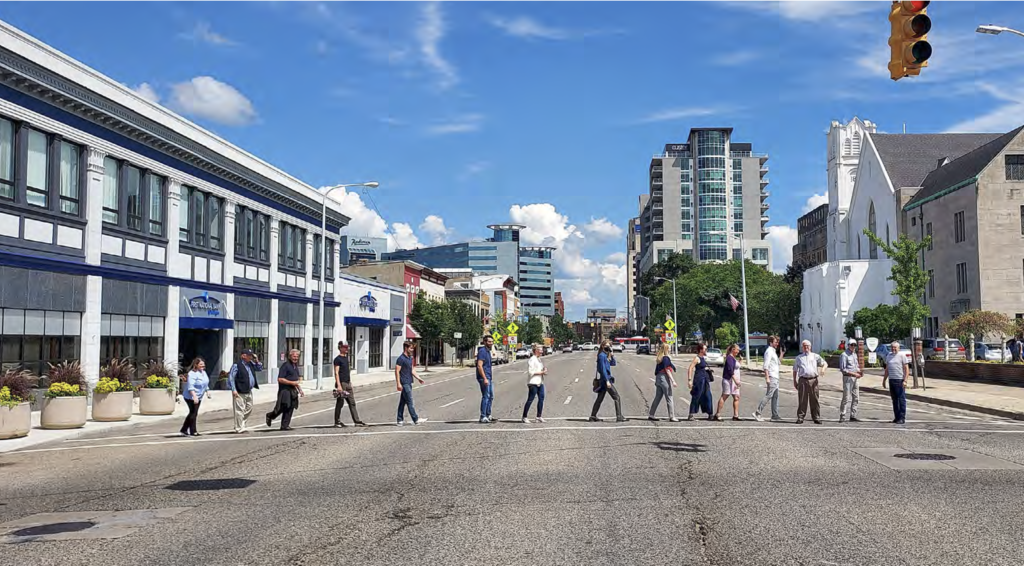
One can look at the changes from Titus Bronson to when Kalamazoo became a city in 1884, and on into the 20th century, and see that “the one-way streets have not been around for that long, and cars have not been around for that long. But, you know, that’s the only thing that we know now, so it does make it hard for us to conceive of anything different,” Peña says.
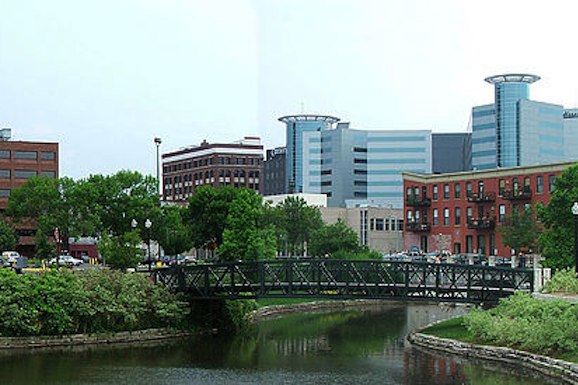
This year, the City is starting the big change, the conversion of our main streets back to two-way.
“Why are we doing this? Why do we need to change history?” Peña asks.
“I think that the streets are not conducive to an urban setting, now, truly. An urban setting is not meant to be moved through,” he says.
“One-way traffic going from east to west on Michigan, really, what it’s serving to do is get me to I-94. That’s not conducive to me driving a little bit slower and looking around, and having an easy time being able to stop at shops and interact with the environment,” he says.
“This is not a unique scenario to Kalamazoo either, you know.” Other cities are grappling with this issue, he says, and making changes to their traffic infrastructure.
“We shall see.”
We talked to historians, not futurists.
Will all the construction delays and rerouting be worth it? Or will the change simply confuse people used to the old traffic patterns?
Houghton says, “Now that we institute all this work in turning these things back to two-way, and calming traffic and everything else like that, what that’s going to mean in the long run? I don’t know. Just like the (Kalamazoo) Mall was an experiment, I think this is an experiment, too. And there might be some people that might be able to adapt to it better than others.”
Ferraro says, “People get used to a change. They really do. And it seems really disruptive at first. But then after a little while, you learn your way around.”
Kalamazoo was a very different place 200, 100, and 50 years ago. There’s a good chance that things will be pretty different in the next 50 years.
Will we even be able to afford gas-burning cars? Will there be modes of transportation other than cars? Bikes? Feet? Electric scooters? The City wants more people to live Downtown — will they each own cars that need a place to park?
“It’s interesting,” Ferraro says. “As the city evolves and changes, if we can keep that character — you know, the people are the big thing, obviously — but if we can keep that character of a town that takes care of each other, and actually has the variety of services and businesses that people need,” that’s the important thing, she says.
Houghton gets the closing statement with what she feels is safe to say about Downtown after the coming changes: “We shall see.”
Editor’s Note: This story is the first in a series that explores the ongoing transformation of downtown Kalamazoo. From a new arena rising to fresh businesses opening and festivals drawing crowds, these changes are redefining how we experience the heart of downtown. This series is sponsored by the City of Kalamazoo.
Author

Related Articles
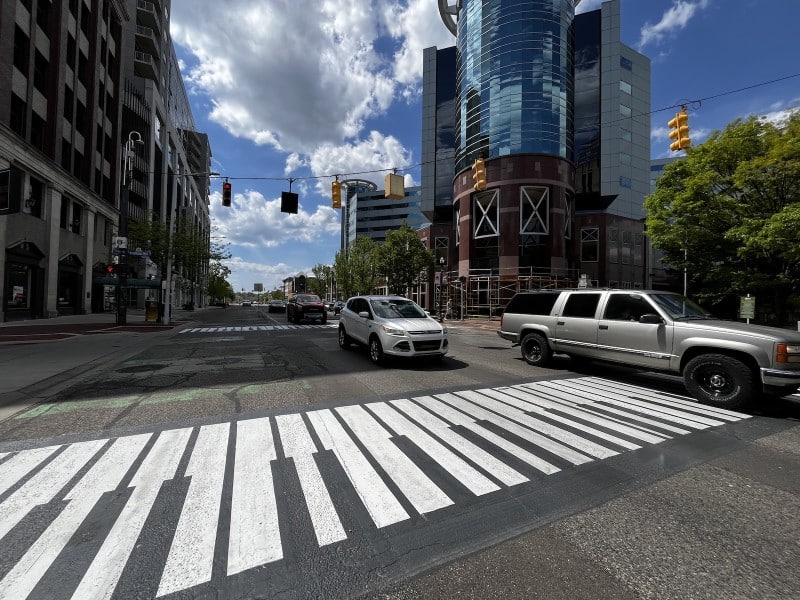
Kalamazoo asks residents to take a close, personal look at streets on walking audit for ‘Design It! Downtown’
A lively Downtown Kalamazoo walking audit highlights community-driven ideas and upcoming “Streets for All” improvements aimed at creating a safer, more welcoming, and pedestrian-friendly city center.
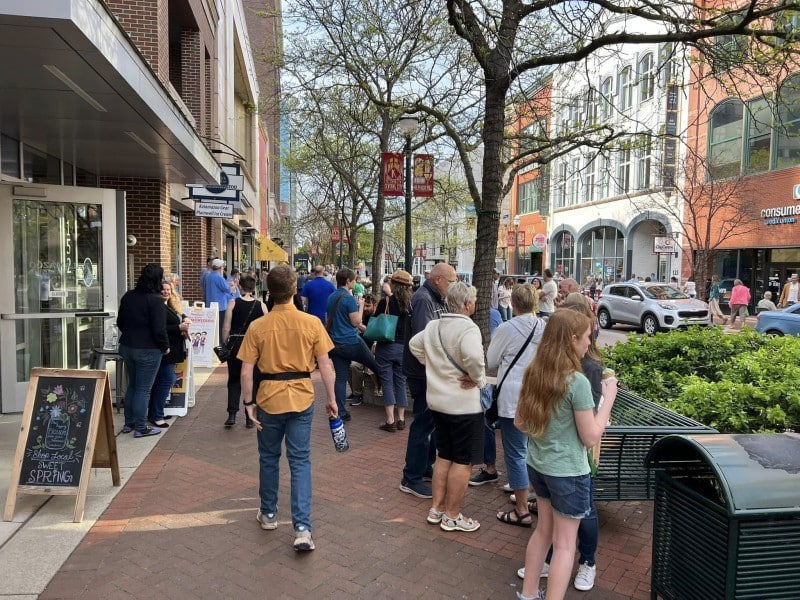
Voices of Youth Commentary: New happenings downtown — one teen’s perspective
Downtown Kalamazoo is undergoing rapid redevelopment that promises economic growth and increased activity but raises this Voices of Youth writer’s concerns about losing historic buildings, disconnecting communities, and creating inclusive spaces.
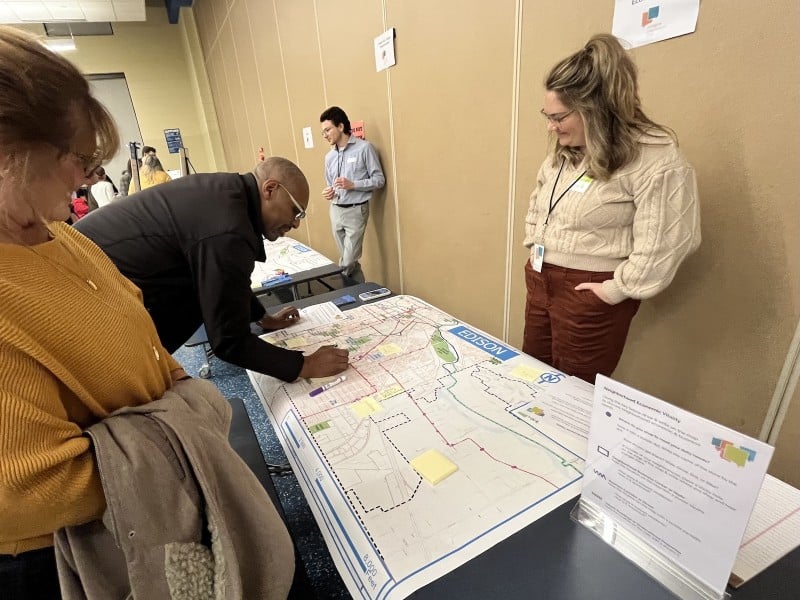
Edison residents take opportunity to Imagine Kalamazoo 2035
Edison residents kicked off Imagine Kalamazoo 2035 by turning potholes, sidewalks, and other everyday neighborhood concerns into hands-on input about the city’s long-term future.