
Voices of Youth: Learning to live with artificial intelligence requires some deep thinking
AI’s growing use in schools raises concerns about student over-reliance, critical thinking loss, academic integrity, privacy risks, and environmental impact while offering efficiency and accessibility benefits.

Editor’s Note: Jonathan Solonika reported this story, and Savannah Scheffers created the accompanying artwork and photos as part of the Winter 2026 Kalamazoo Voices of Youth Program. The program is a collaboration between Southwest Michigan Second Wave and KYD Network in partnership with the YMCA of Greater Kalamazoo, funded by the Stryker Johnston Foundation. The Voices of Youth Program is led by Earlene McMichael. Al Jones (writing) and Casey Grooten (art) served as mentors.
KALAMAZOO, MI – “He wanted to get caught,” Charlene Boyer Lewis says of a college student she recently caught using artificial intelligence to write an assignment.
“I have had a student say, ‘I was just waiting to get caught,’ ” explains the professor of American history at Kalamazoo College.
Artificial intelligence is so prevalent and easily accessible that some say using it is becoming addictive. Boyer Lewis says she does not know about that. But what she does know is that her student was relieved after he was caught, she says, despite warnings against the use of AI in classwork, which tells her that some people are using it way too much.
“ ‘I wanted to get caught,’ ” she says the student told her. “And ‘This will be a turning point for me.’ ”
She says he sounded as if he would now be doing things differently. She says she thinks students are using AI to help with their assignments when they are rushed for time or stuck on an assignment.
Artificial intelligence, more commonly known as AI, is a term we’ve all heard more and more of over the years. It is technology that allows computers and other machines to mimic human intelligence and solve problems, as well as create documents, artwork, letters, pictures, speeches, verbal responses, and other things.
Some say it’s a tool that benefits everyone. It is quick and easy to use. Others say it’s harmful technology that will be used to hurt others, invade human privacy, and mislead people into believing false information. Among those who question its use are people who say online AI platforms have stolen their research, artwork, or intellectual property. And some worry that AI is making access to answers so fast and easy that young people aren’t really learning for themselves.
Is AI dumbing down its users?
“I know I used to use AI in eighth grade,” says Savannah Scheffers, now a 16-year-old sophomore at Schoolcraft High School. But she says she tries not to use it now. What changed?
“I think it was just when it got to the point where I was looking around me, and they (other students) don’t even try to do stuff anymore,” she says. “They won’t try an assignment. They’ll copy and paste an assignment’s rubric into AI and say (tell it to) ‘Give me something.’ ”
With computer searches, AI shows up without any prompting to helpfully summarize concepts and define terms. But Boyer Lewis says she has made it abundantly clear that AI is not allowed in her classroom, and that she is willing to fail any student who uses it as anything more than a guide to help them do their own research. However, she and other educators say they are checking more often and more diligently for students using it to complete their assignments, and in some cases, to copy work they did not do.
“We have a professor here who teaches poetry, and he’s getting AI-generated poems,” Boyer Lewis says.
Scheffers says one of the reasons she tries not to use AI is, “I don’t want something thinking for me. And I think that’s a lot of what AI does for you.”
She says almost every app she tries to use lately has some kind of AI running through it. “Even my email, you know,” she says. “You’ll open your email and it’ll be like, ‘Let’s summarize this email for you.’ And it’s (the original message is) like two sentences, and you’ll say, ‘You don’t need to do that.’ ”
Boyer Lewis says she has a friend who is a digital arts professor. That colleague is trying very hard to come up with assignments where students stay creative and do their own work, but it’s becoming harder and harder.
“It’s much easier to teach painting and drawing,” she says. “But if you take a poetry class and you don’t want to write a poem and you want AI to write the poem for you, what are you doing?”
What’s the worst part from a teacher’s point of view?
Tama Salisbury, assistant principal at Portage Central High School, says the downside for youth is that it’s very easy to go to AI and get an answer quickly. “Because of that, it might create an overreliance on the tools to do thinking for you,” she says. “So, I think that would be a downside. If you are not self-aware and able to be disciplined with AI and its tools, and really do critical thinking before you use it, you could turn into some problems that you weren’t expecting.”
Salisbury, who has taught social studies and history, has noticed this. “I’m not a teacher anymore. But when I was in the classroom (her last year in the classroom was 2018-19), there was still a concern, even then, about the internet and plagiarism and the availability of so much information online.”

Teachers have always worried about students taking someone else’s work and copying and pasting it into their assignments, rather than reading and absorbing it. They know that it is super-easy with AI.
“With AI, you don’t always know where the information is coming from,” she says. The tools to identify where information is coming from are getting better, she and other educators say.
How does AI impact news?
Boyer Lewis says she believes AI affects people’s understanding of history “for the worst” because it summarizes lots of information, and a lot of situations may be misunderstood. AI often removes important data because it shortens and distills it, unknowingly removing the complexity, “because to the AI, it is clutter,” she says.
“So, you lose complexity. You lose nuance. And I always tell my students that history is complicated and messy,” she says. “AI gets rid of the mess and gets rid of complexity. It wants to simplify everything.”
Asked how AI affects news reporting and asked if using it allows misinformation to worm its way into newscasts and articles, Jon McCrary says news stations have a vetting process to ensure that the information it receives is accurate and authentic.
“The vetting is based on eyewitness accounts and interviews or conversations with witnesses, which would provide multiple accounts of an event,” says McCrary, who is the former assistant news director at WWMT-News 3, based in Kalamazoo, Michigan. “If the video does not match other accounts, it’s probably fake.”
He says, “We have more of a problem of people embellishing an event during an interview than someone providing a video that is AI-generated. “
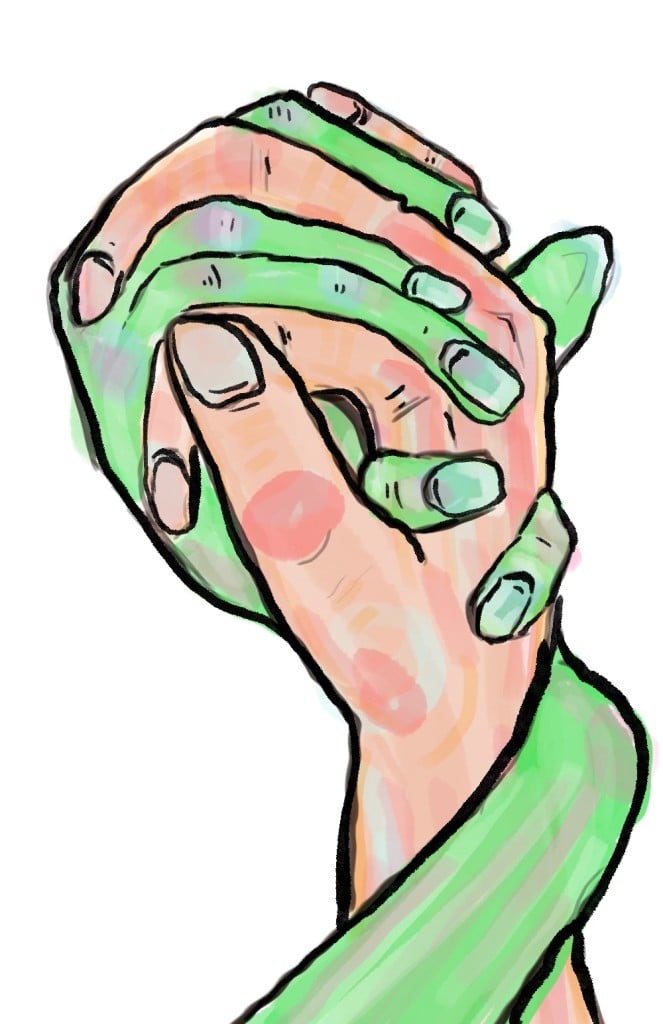
The artist focused on hands because AI generative art models seem to have difficulty in recreating realistic, anatomically correct human hands. In this piece, Scheffers shows a human hand enclasped with a green hand meant to represent one generated by AI.
From McCrary’s perspective, WWMT has not used AI-generated material. “Personally, I do not know of a local station or network that has been sucked into airing fake material.”
The process they go through if that does happen is to issue a correction and an apology to their viewers. “We believe in full transparency,” he says. “If we make a mistake, we have to admit it. It is a standard journalistic process.”
To fact-check to make sure what they’re reporting is reliable, they cross-reference sources. “We have a rule of double-source confirmation. We don’t believe one person. If more than one person (independently) tells us the same thing, it must be true. This concept is another standard journalistic standard.”
Where does helpfulness end and the loss of privacy begin?
Salisbury says she never uploads anything that indicates where she works. As a matter of fact, she routinely scrubs data on her computer to make sure she doesn’t mistakenly broadcast information about any of the 1,600 students at Portage Central High School, where she has been assistant principal for the last three years. Scrubbing refers to protecting personally identifiable information that you load into a tool. Despite that, a pop-up on her computer recently suggested that she customize her documents to include references to “Mustangs,” the nickname for the school’s teams.
Even if AI is helpful to individuals, what does that mean for the many people who create work that AI platforms are sharing? Will it just be part of a large repository of information and get all mashed up with the work of others? Is the creator going to be compensated for what they’ve contributed?
AI platforms scan and digitize books. Then they are sent to an AI’s website without any credit being given. But publishers recognize when the content of their books is stolen, as they know where their books are downloaded and repurposed.
Boyer Lewis says one of her books, “Ladies and Gentlemen on Display: Planter Society at the Virginia Springs, 1790-1860,” has been downloaded by AI without credit. And her husband’s four books have been taken as well. He is also a history professor. They are part of a class-action lawsuit against the AI platform for the alleged theft of intellectual property.
AI has an impact on the environment
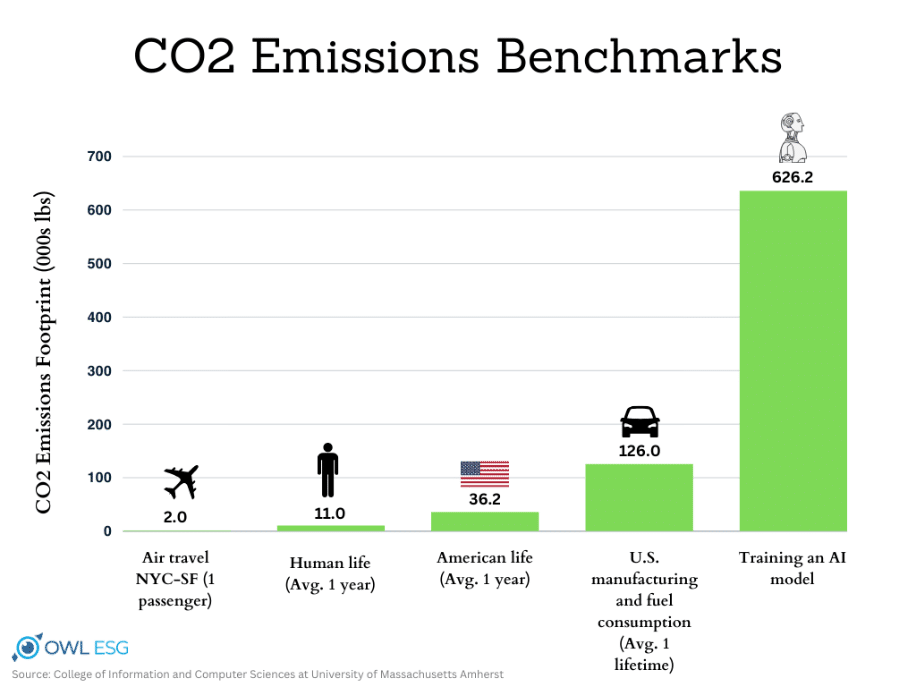
Large data centers are being created to support AI. They are large buildings filled with computer servers. Inside them, AI models are “trained.” And they are “pinged” every time someone asks a question, according to a December 2024 posting in MIT Technology Review magazine. It explained that a huge amount of electricity is required to run the servers and to keep them cool. In the process, the centers produce a major amount of harmful carbon dioxide.
According to Karen Hao, an award-winning journalist who works at the Massachusetts Institute of Technology on the MIT Technology Review, the process of “training” several AI models emits more than 626,000 pounds of carbon dioxide. That is nearly five times the lifetime emissions of the average American car, including the manufacturing of the car itself. The size of the data centers is also significant.
“Even a mid-size data center consumes as much water as a small town, while larger ones require up to 5 million gallons of water every day — as much as a city of 50,000 people,” says Jon Gorey, a staff writer at the Lincoln Institute of Land Policy.
In a January 2026 posting on the subject, Mike Weinstein, director of sustainability at Southern New Hampshire University, explained, “AI data centers are currently located in areas with grids predominantly powered by fossil fields, meaning coal- and gas-fired power plants. These are fuel sources that contribute to global climate change by releasing greenhouse gases into the atmosphere when they are burned.”
Emissions from data centers have tripled since 2018, according to the MIT Technology Review. It surveyed 2,132 data centers in the United States and determined that from August of 2023 to August of 2024, data centers accounted for 2.18 percent of all the harmful carbon dioxide emissions in the U.S. It expects that amount to grow, based on the rapid growth of AI technology since the popular ChatGPT was introduced in late 2022.
What does AI go from here?
From an educator’s point of view, AI creates both problems and opportunities, Salisbury says. Over the past two to three years, Portage Central High School has seen more students get disciplinary referrals for using AI, particularly around the time when most papers are due. “Rather than being copied and pasted from sources, it’s an AI referral rather than what would be considered historic plagiarism,” she says.
What are the positives?
“The opportunities are to help create that self-discipline in a media-rich world,” she says. “The efficiencies are the benefits. The drawbacks are the overreliance. And the problems are for those students who are not self-disciplined — the concern over developing appropriate critical-thinking skills, not losing your human advantage, and not necessarily evaluating the material that comes back at you.”
To her, the human advantage is “critical thinking, empathy, compassion, and being able to be intuitive to other human beings and what their feelings are.” She adds: “Those things can’t be replicated with a machine.”
Scheffers, of Schoolcraft High School, offers this thought: “I am hesitant when posting things online because of AI. People will have AI involved in stuff, scanning through and downloading artwork, and using it to kind of extract data from it in order to replicate it. I am also very cautious when I am looking at other people’s artwork to see if it’s real. Did someone actually produce this, or is this mechanically made?”
When Boyer Lewis was asked if AI is benefiting or harming society as a whole, she responded: “There are places where it is useful, but not in the classroom. It takes away all things that make us human.”
Salisbury says she expects AI to become a larger part of life and her job, however.
“One of the reasons I think that’s true is because we’ve been engaging in a lot of professional learning around AI and how it can be used to create efficiencies in the work that I do and in the work that other people do,” she says. “So, I imagine that it’s going to be impactful.”
Jonathan Solonika is a freshman at Loy Norrix High School in Kalamazoo, Michigan. This is his first journalistic piece, but he plans to continue with journalism in the future. In his free time, Solonika enjoys playing video games, listening to music, and participating in theater. He plans to pursue acting after high school.

Savannah Scheffers is a 16-year-old sophomore attending Schoolcraft High School and the Kalamazoo Area Math and Science Center. Savannah enjoys painting, reading, and creating collages. Her favorite subjects in school are History and English. This is her third time creating art for Voices of Youth. She participates in the Voices of Youth cohort because she believes that art has the power to unite people around a common cause.
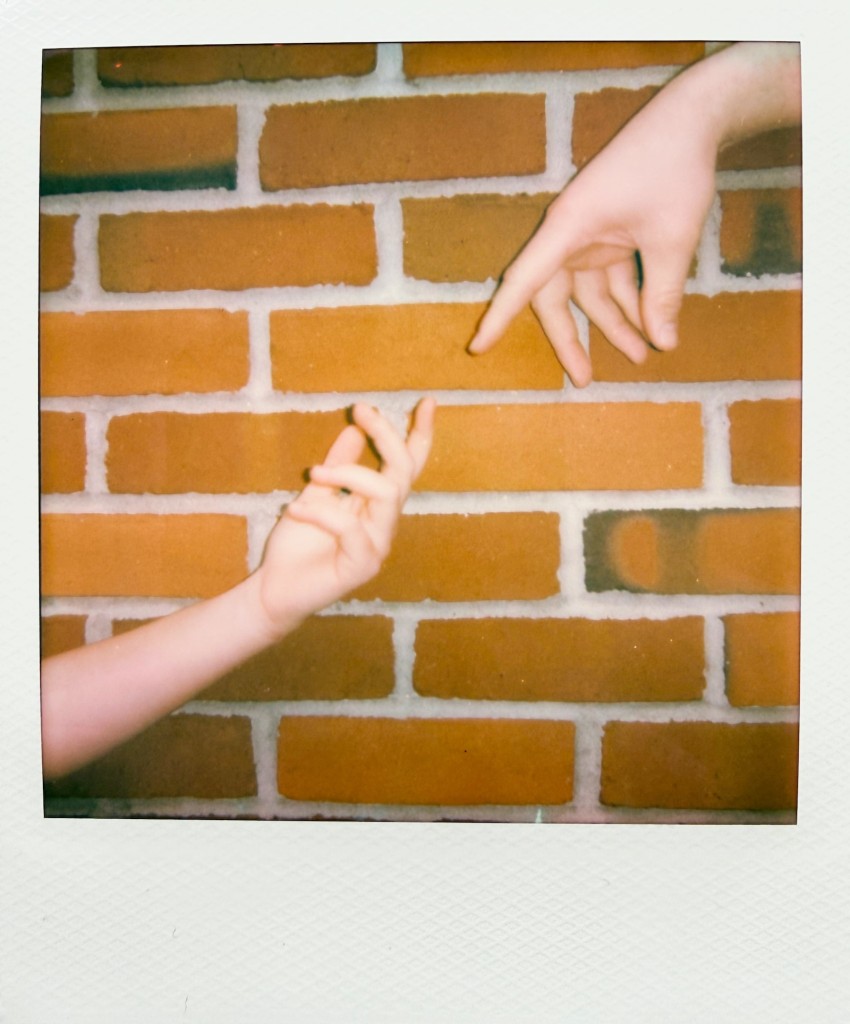
Artist Statement: “When reflecting on the relationship between humanity and art history, hands remain one of the most connecting factors between the now and the then. Hands have the ability to physically connect and disconnect people: hands interlock with one another, or grasp or push one another away. Looking back, one of the first examples of art is handprints of outstretched hands on cave walls. In paintings, hands are often avoided because of how difficult they are to create accurately. Artificial Intelligence often disfigures or deforms hands when generating them. AI exists as a tool, but unlike tools of the past, it renders itself as exponentially powerful; existing less as a tool and more as a replacement.
“Inspired by this phenomenon, I created ‘A Timeline of Hands,’ showcasing a spray paint on paper representation of hands on a cave wall and a polaroid picture with hands reaching to connect in reference to Michelangelo’s Creation of Adam, and a digital image of a human hand attempting to hold hands with the ‘hand’ of AI, which seems normal on the surface, but wraps around the human hand in attempts to choke it.”
Author

Related Articles

Coalition proposes that no family pay more than 7% of their income for child care
Universal Childcare without Conditions centers affordability for families and sustainability for providers.
Kalamazoo nonprofit ElderUP helps seniors stay active and connected through free community programs
Kalamazoo nonprofit ElderUP is helping adults 60+ stay independent and socially connected through free, accessible programs that promote fitness, creativity, and community engagement.

Home-based providers call for flexibility as Michigan expands Pre-K for All
Home-based providers could be significant to making Pre-K for All available to more children.