City of Kalamazoo wraps up Kalamazoo Avenue construction for 2026
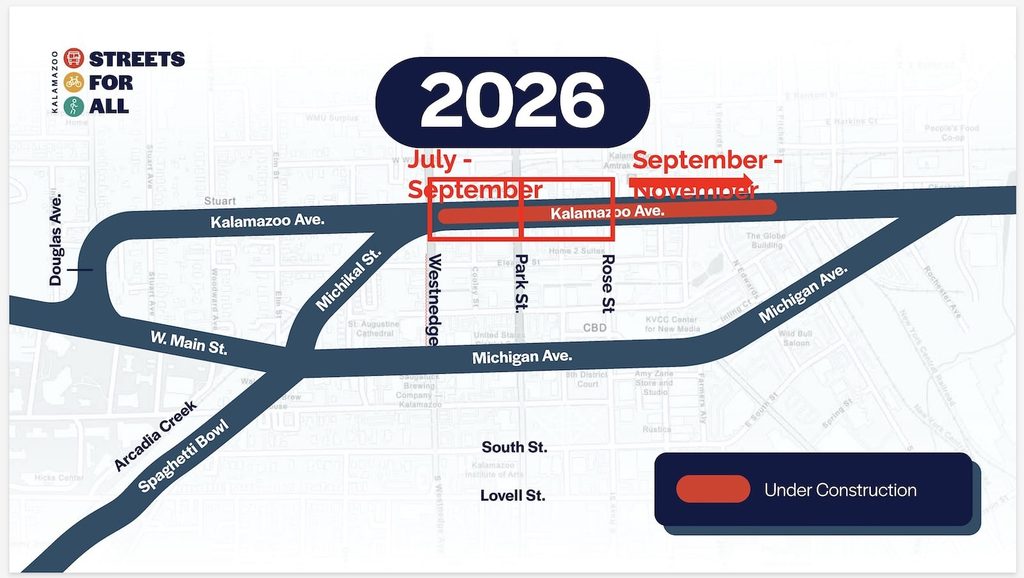
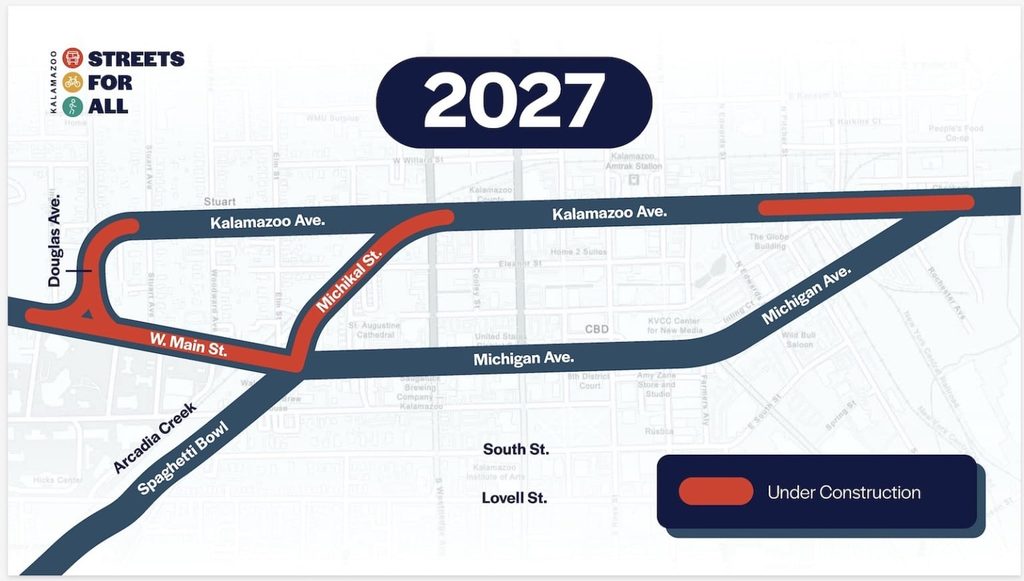
Around St. Patrick’s Day 2027, depending on the weather, constuction will resume eastward. Construction on the Douglas Avenue and West Main Street intersection, West Main at Michikal Street, and Michikal to Kalamazoo Avenue area also planned.
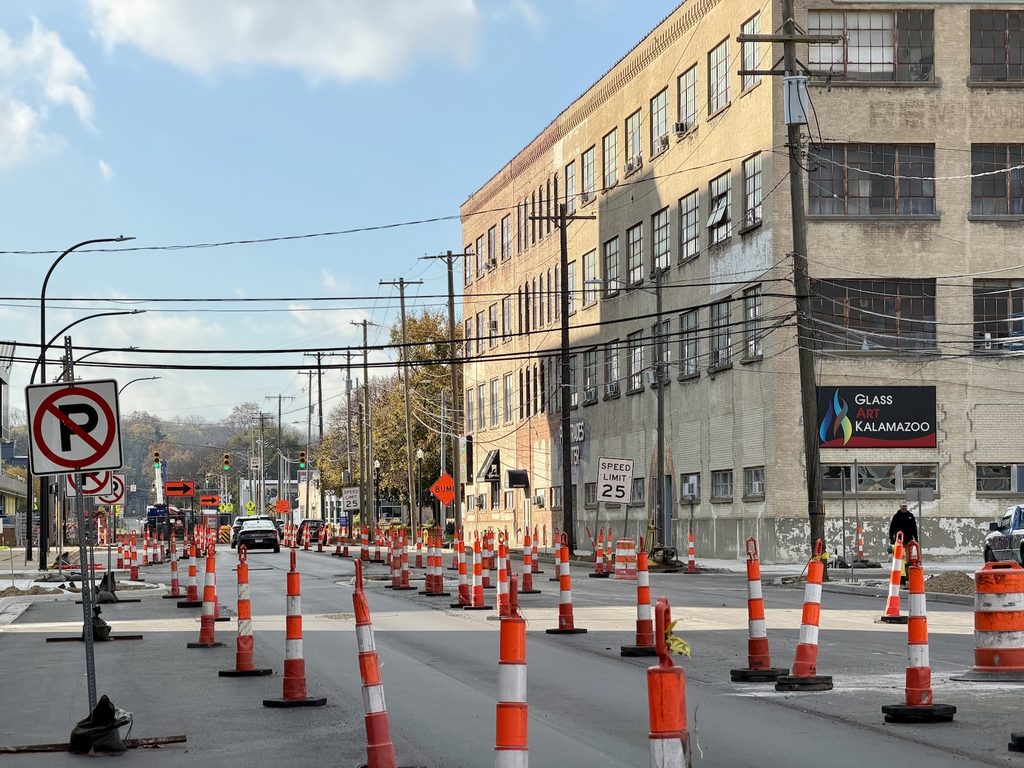
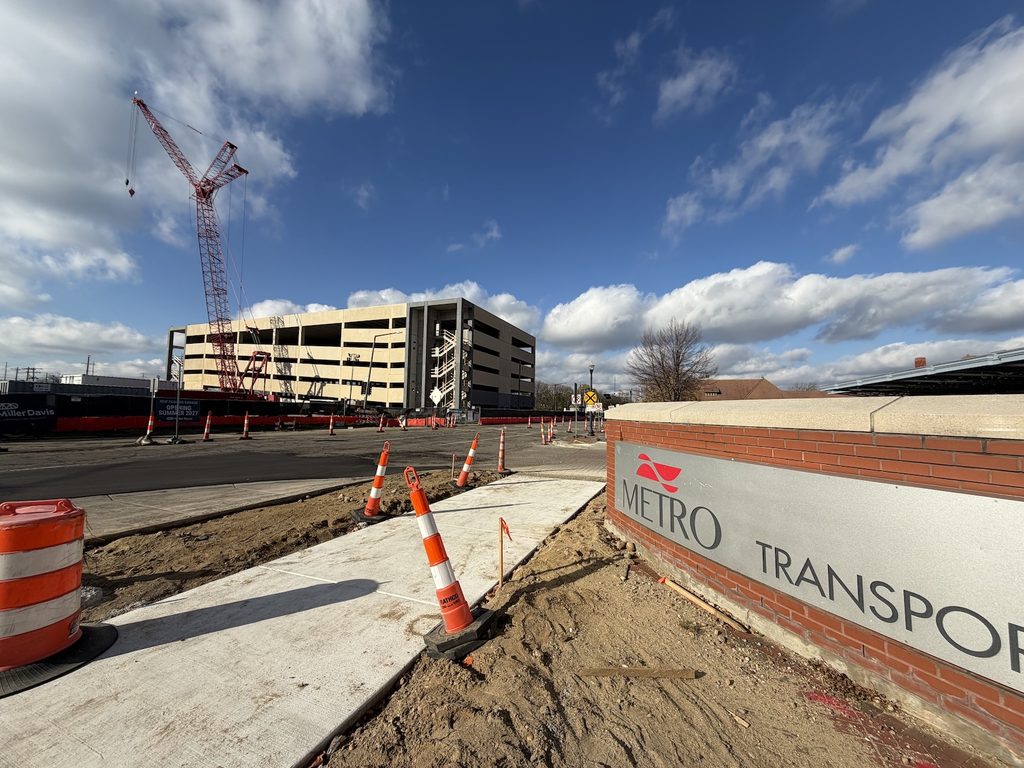
Kalamazoo Avenue construction, from Park Street to Burdick Street, is done. (Photo by Mark Wedel)
For now, it’s done. The construction season will end by Thanksgiving. Then around St. Patrick’s Day, depending on the weather, it will resume eastward.
Also, next year we will see construction on the Douglas Avenue and West Main Street intersection, West Main at Michikal Street, and Michikal to Kalamazoo Avenue. The City intends to keep one lane open on these streets, so traffic can still move, as it did during construction on Kalamazoo Avenue.
The conversion of Downtown’s one-way throughways into two-way streets, with all the accoutrements of traffic calming, new lights, infrastructure for pedestrians and bike riders, should be complete by 2030.
(Related: Read Second Wave’s look at the coming changes for 2026-2030 here.)
‘Not trying to totally disrupt the world’
Everything is going as planned, Dennis Randolph, traffic engineer and Public Works Manager for the City of Kalamazoo, says.
Between the intersections of Park Street and Burdick Street, “basically, the road is built,” Randolph says. “Now, there’s always stuff to do, you know — clean up, and we have to paint the road, and do some final things like that, which we will do over the next two weeks, by Thanksgiving.”
This winter, two lanes will be open. They’ll still be one-way, but they will be where the two-way lanes will be when the conversion is finished, Randolph says.
The Event Center’s construction will continue west of Park. They, and the City, face a “hard deadline,” Randolph says. The Center expects to be open and hosting events in September of 2027.
That’s next year, when Michikal at Kalamazoo and Westnedge will see work under the Protect Grant.
But let’s not get too far ahead of ourselves. On Kalamazoo Avenue, after this year’s construction season, beyond the new pavement, there are seen and unseen changes
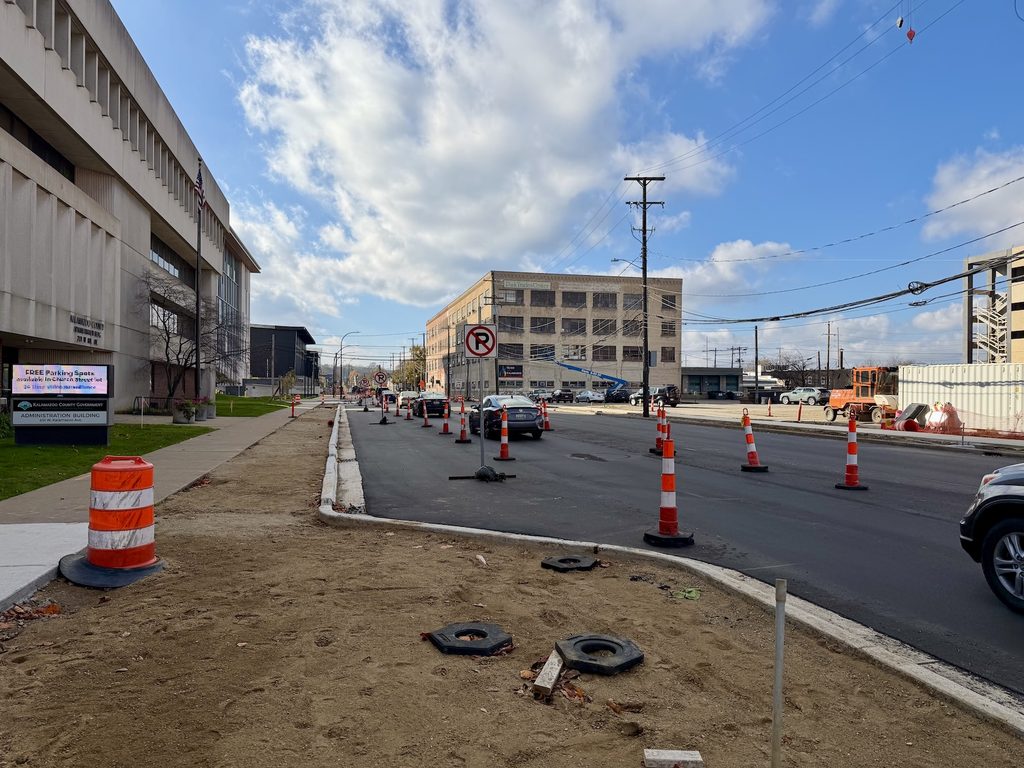
Seen: There are new sidewalks, curb bump-outs, and a pedestrian island at North Church Street. The traffic-calming and pedestrian-supporting infrastructure give a taste of the City’s Streets for All mission.
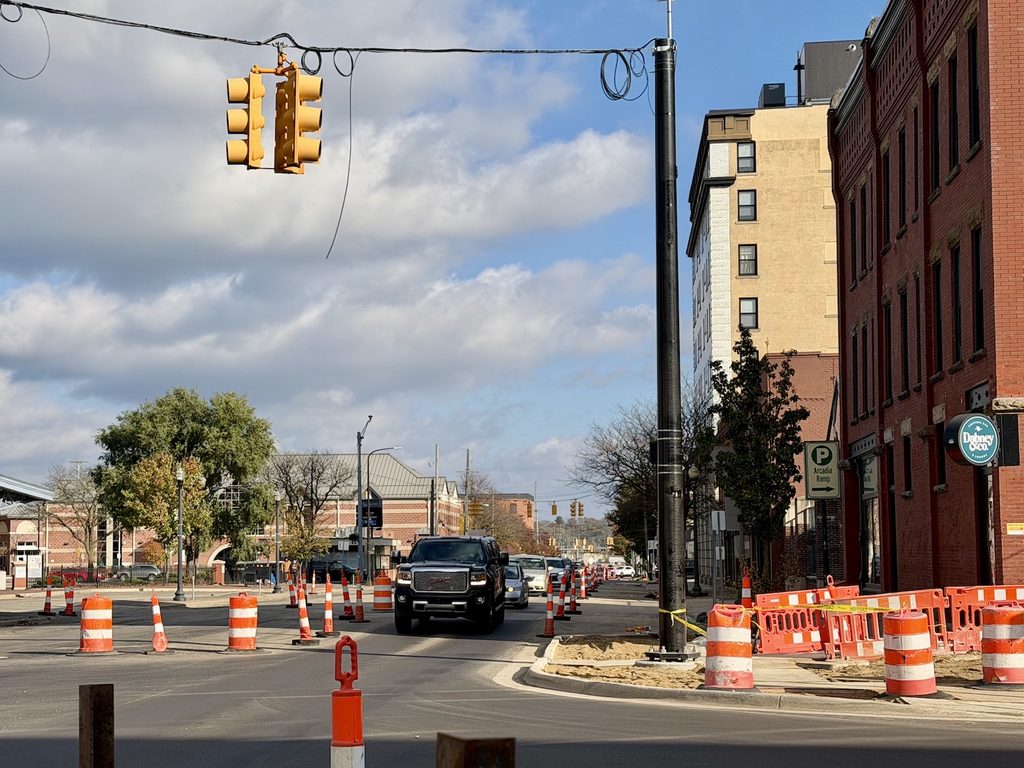
Unseen: Underground are new “duct banks,” pipes for power and communication utilities. The old poles and their nets of wires over the street should be gone next year, Randolph says, when Consumers Energy puts their wiring underground.
This will protect power and communications from storms and other destructive forces, he says.
It’s also cosmetic. Moving wires underground is “a big piece of work done by their (Consumers Energy) contractors. But it’s going to allow us to remove all those ugly big poles and all those cables that are hanging out there. So it’ll really be a change for Kalamazoo,” Randolph says. “It’s going to be a good-looking street.”
Long before the project, he knew that around a century-and-a-half’s worth of old infrastructure would be found underground. But the amount and complexity still surprised Randolph.
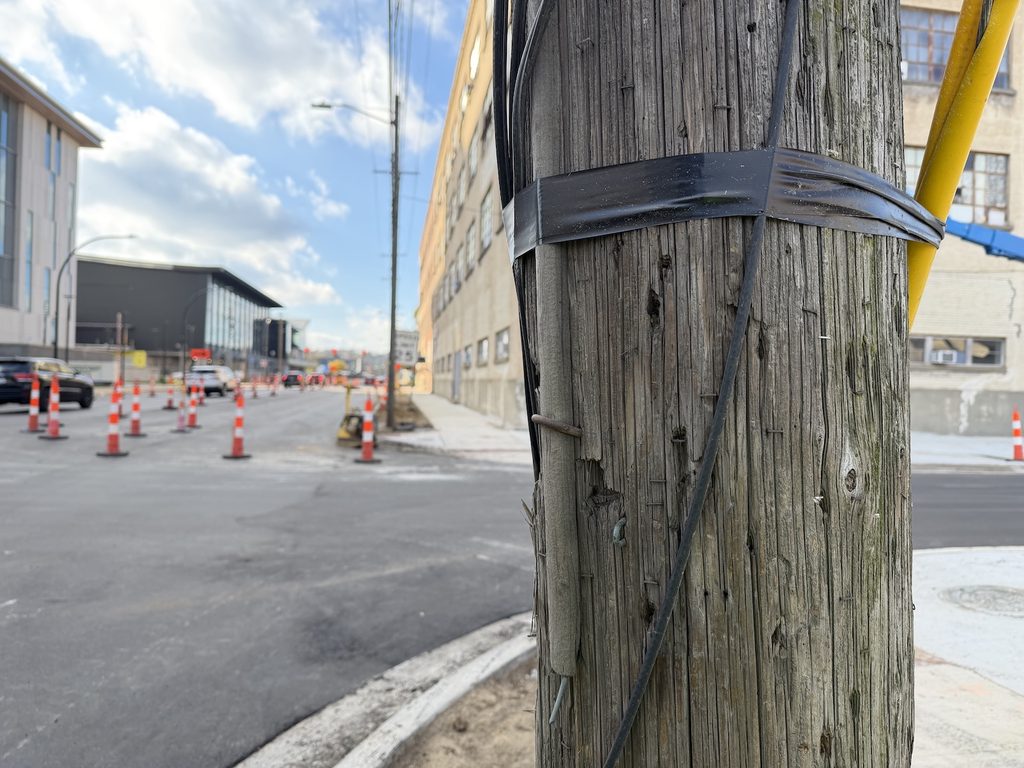
Say goodbye to our old poles. Consumers Energy installed underground pipes for wires; power and communication connections are set to be taken below pavement next year. (Photo by Mark Wedel)
“There are so many underground utilities along the street that it has just taken an immense amount of effort between our engineering staff and the contractor to make sure that all those pipes and tubes and sewers and water mains were kept working. And it’s a real dense network of infrastructure that people don’t see. It’s buried now under our curb and our new pavement. But there was a lot. It surprised me. I’ve been building these roads for a long time.”
The other surprise — even though it was the plan all along — was that they’ve been able to keep traffic moving through the construction zone, Randolph says.
“And the fact is that I know somebody will say, ‘Well, I had to go slow.'”
But, “a lot of traffic has continued to travel down Kalamazoo. So we were able to, I think, minimize a lot of disruption for folks.”
Randolph continues, “I would hope that (frustrated drivers) understand that we’re doing a major project, doing a lot of things, not just road, but utilities of all sorts, water, everything.
“You look at the Event Center, right? And there are all kinds of things going on there. But unlike our project, they don’t have 15,000 cars a day driving right through the middle of their construction site. Kalamazoo does.”
Since beginning in July, there have been “some crashes,” but no serious ones along the site, Randolph says. “Our construction workers are exposed to all of those cars when we do this. And now, is it worthwhile? Yeah, it’s been very worthwhile to keep traffic going.”
He adds that this has been a successful test of their plan to keep one lane open during future construction for the project. “I hope, you know, people can see that we’re really trying not to totally disrupt the world as we rebuild Kalamazoo.”
‘Construction is just challenging’
There’s a perception that travel Downtown, during the construction has been a nightmare.
Randolph has been keeping an eye on the street, literally, with his office monitors showing live camera views of the construction. “I see traffic moving right now,” he says on a weekday morning, approaching lunchtime.
He also walks it once a week, and of course drives on Kalamazoo Avenue often.
He figures the construction has slowed his drives down the street by about a minute, “maybe two.”
However, there are signs that business has slowed Downtown.
Over the construction months, “we’ve heard directly from some businesses that they’ve experienced reductions in sales,” Meghan Behymer, Downtown Coordinator for Downtown Kalamazoo, says. “And we know how significant that can be, particularly in Kalamazoo, with a lot of local small businesses.”
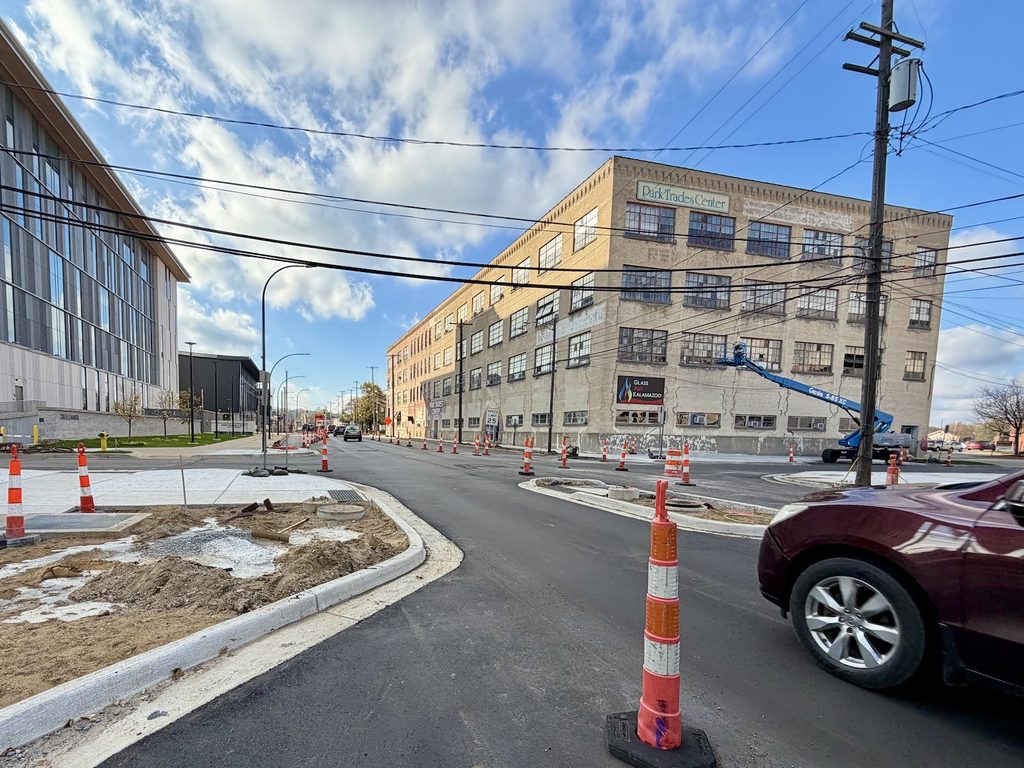
Downtown Kalamazoo has “been trying to remind people that Downtown remains open,” she says.
They’ve provided maps showing how to get around the construction zone, for businesses to hand out to customers. They’ve placed way-finding markers Downtown to guide foot traffic. They have advertised on social and broadcast media, and on billboards.
There’s a new website with a complete Downtown business directory.
They hired a dedicated staff person, focused on “communicating all the great things about Downtown,” Behymer says. That’s Katrina Davidson, Downtown Projects Coordinator, who joined at the start of construction in July.
But perception, and reality at times, has slowed down business in the area. “Construction is construction, and it brings its own challenges,” Behymer says.
There were accessibility issues, with sidewalks and parking spaces blocked, she acknowledges.
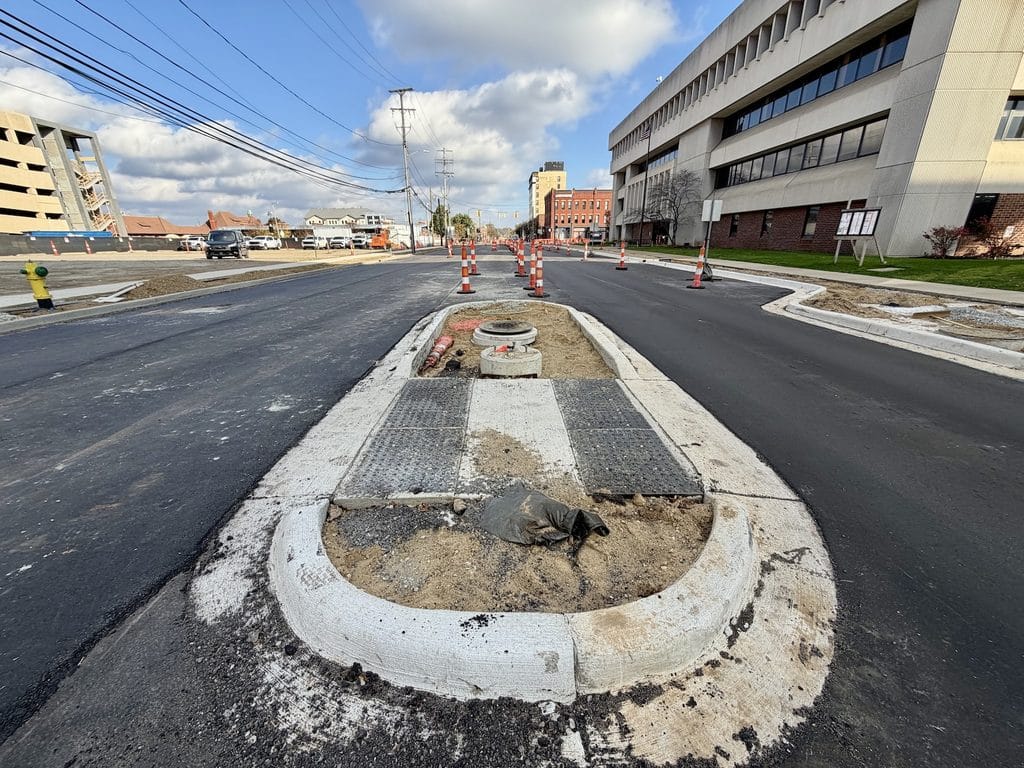
Pedestrian islands also provide a safe spot for walkers crossing wide streets. (Photo by Mark Wedel)
“We’ve tried to be accessible to our businesses and take their concerns seriously, and create those practical solutions wherever we can,” she says.
Downtown Kalamazoo sent weekly emails to businesses, detailing the process and highlighting routes customers could take. That helped, Behymer says, but “it doesn’t take away this perception of construction, that it can be challenging to navigate.”
Over this summer and fall, “I think we’ve learned that maintaining physical access is only part of the equation. People need to understand how do they get to businesses and feel confident doing so.”
Next year, Downtown Kalamazoo will continue its work “offsetting this narrative that construction is just challenging. It is, but it’s also worth it,” Behymer says.
Changing for the next century
“We’re making change. We’re rebuilding downtown,” Randolph says.
As Downtown’s changes get closer to being complete, he says he feels we will see the benefits.
Having streets more friendly for visitors will be an economic boost for the City, he says. People arriving and departing at the Metro/Amtrak station will have a Kalamazoo Avenue that’s easier and safer to navigate on foot.
He points out that there will soon be the new County parking garage at North Rose Street, across from the station, opening next year. The Event Center will have its own parking garage and will bring a lot of foot traffic Downtown. Students from Western Michigan University and Kalamazoo College will find it easier and safer to walk or bike to patronize Downtown businesses.
But the “bottom line” for Randolph is less speed.
The speed limit for Kalamazoo Avenue as one drives in from the east is 35 mph, then drops to 30 mph in Downtown.
The speed limit isn’t changing, but the streets are, he points out. The lane reductions and eventual two-way configuration on Kalamazoo Avenue are meant to slow drivers to the actual speed limit.
Looking at the new pedestrian island and the curb bump-outs on the other side of that lane of travel, one can’t help but note the narrowing of that specific lane – though cars didn’t appear to have difficulty driving through.
The bump-outs also provide more of a separation between traffic and cars in the parking spaces in front of the Kalamazoo County Administration Building.
That might make one think of the crash in February, back when Kalamazoo Avenue was in its former, un-traffic-calmed state. Two cars collided, sending one on a trajectory into the County Building, into its lobby, to collide with its elevator.
Are the changes meant to stop crashes like these?
“Absolutely,” Randolph says at the mention of that collision. “In particular, we need bump-outs and islands because some really thoughtless drivers will try to use our center left-turn lanes and parking lanes to pass and speed on. This, besides being illegal, is extremely dangerous. A few seconds is not worth someone’s life or health.”
Speed is a factor in severe crashes, he points out.
Randolph is ready with the exact numbers: Kalamazoo was ranked 17th in Michigan cities for number of crashes, 2016-2019, with 3,627. Between 2022 and 2025, there were 2,808, a 22.6% reduction, putting us at 21st.
He wants us lower on that list. “There are a lot of cities in Michigan bigger than Kalamazoo. We shouldn’t be ranked that high.”
Randolph has no time for those who don’t want to be slowed to the speed limit. “Why don’t you care? Why don’t you care about hurting people?”
He thinks of his grandchildren, now 6 and 3, who’ll “be around in Kalamazoo through the rest of this century.”
“I’m doing as much as I can to make sure that the streets are safe for them and everyone else’s grandkids, because they’re the ones that are going to be driving on these streets the rest of the century,” he says. “Not people who have been driving on these streets the last 50 years as fast as they could. It’s the future people that we want to protect.”
So far, after the first step in the big two-way conversion project, Randolph says, “I’m seeing Kalamazoo Avenue turning into a place that was strictly a speedway for people, into a street that it really is nice to walk up and down. It’s safe to walk up and down. And it’ll carry the traffic just fine. And I’m really looking forward to getting this done. It is making a difference.”
Photos by Mark Wedel, taken Sunday, Nov. 8, 2026.
Author

Related Articles
Think small, go far: Save gas with this one fun trick!
As gas prices climb, Kalamazoo residents are exploring e-bikes and other micromobility options to save money, improve transportation efficiency, and rethink how they get around safely.
Feeling slowed down? That’s the point. Kalamazoo crashes drop 25%.
Kalamazoo’s traffic calming makes roads safer for everyday mistakes, while enforcement targets truly dangerous driving.
Elbows up, hearts open: One Kalamazooan’s ride across a bridge built to connect
Kalamazooan Mark Wedel bikes the new Gordie Howe International Bridge, discovering history and connection as he pedals across the border from Detroit to Canada.