

University students and faculty: Balancing AI’s usefulness and its costs
As AI reshapes higher education, Michigan students and faculty navigate its benefits and challenges, from academic integrity and career uncertainty to creativity and the technology’s environmental costs.
Editor’s Note: Planet Z: Voices of Youth for a Sustainable Future is a Gen Z–created series sharing unfiltered perspectives on climate change — from eco-anxiety and grief to the urgency, creativity, and resolve shaping their generation. Support for this series is provided by Consumers Energy.

Just a few years ago, students would have been hard-pressed to find artificial intelligence policies in their course syllabi. Today, AI has become embedded in nearly every aspect of society, from health care and law enforcement to higher education. Its rapid expansion has forced colleges and universities to confront a new question: How should students and educators navigate a technology that is changing both the classroom and the world beyond it?
After OpenAI launched ChatGPT in November 2022, the use of artificial intelligence in the public sphere exploded. ChatGPT is a form of generative AI, meaning it can create new content using predictive algorithms. As a large language model, it processes vast amounts of data and generates responses based on patterns it finds.
For students, ChatGPT can be used to check grammar, find information, and paraphrase documents. A 2026 survey by the Digital Education Council found that 92% of students worldwide use AI in their studies, a 6 percent increase from the council’s 2024 Global AI Student Survey.
But as AI becomes more common in education, students at Michigan universities and colleges are increasingly concerned about its implications for their futures. Forty-one percent of students worldwide worry that AI will reduce job opportunities in their fields by the time they graduate. Concerns vary by discipline; in the United States and Canada, those worries are highest among students in the humanities and social sciences and STEM fields, and lowest among those studying health and education, according to the 2026 survey by the Digital Education Council.
AI’s Environmental Costs
Students are more concerned about academic integrity and the future of work than AI’s environmental impact. A 2025 study by the Higher Education Policy Institute found that only 15% of students said environmental concerns discouraged them from using AI.
That disconnect is notable because AI has consequences beyond careers and education. Data centers that power AI systems consume enormous amounts of electricity and water. Many operate on fossil-fuel-powered grids, contributing to carbon emissions. Data centers also use water to cool the equipment required for high-volume computing.
A typical data center uses 300,00 gallons of water each day, roughly the same as 1,000 households. Furthermore, large data centers can use an estimated 5 million gallons of water each day, equivalent to the demand of a town of 50,000 residents, according to the Environmental and Energy Study Institute.
“I get frustrated with how AI is built into everything. It is in every search engine, and I think AI overview lessens my skills in discerning what type of information is relevant. The accelerated spread of information will also accelerate the spread of disinformation.” — Sasha Villaruz, junior at University of Michigan
The physical footprint of AI is expanding as well. Data-center developers are purchasing land, including farmland and open space, to build new facilities. Land purchases for future data centers reached $6 billion in the first half of 2026, according to commercial real estate firm Avison Young. A 2025 report from Hines estimated that 40,000 acres of powered land will be needed to support projected data-center growth over the next five years.
As AI rapidly develops, students and faculty are grappling with its changing role in both the digital and physical worlds. Universities are rewriting policies, educators are redesigning assignments, and students are reconsidering how — and why — they use the technology.
Students Navigate AI in the Classroom
Sasha Villaruz, a junior studying chemical engineering at the University of Michigan (UM), has experienced that evolution firsthand.
“When I was a freshman in college, I was mostly in prerequisites, where I could copy-paste my homework into [ChatGPT],” said Villaruz, who is 20. “I didn’t have to scour the internet anymore, and while it didn’t work great at first, it just kept getting better.
“A lot of my professors use AI themselves for lesson planning and know that we use it for our work as well,” she said.
As her classes became more complex, however, Villaruz began using AI less frequently because there wasn’t one “right answer” for her class assignments, and AI was pulling from sources she didn’t learn about in class. “It could be the right answer, but not what the professor was looking for,” said Villaruz.
Over the summer, Villaruz completed an internship at Reckitt, a consumer goods company that produces health and hygiene products. The company uses an AI assistant integrated into its workplace technology.
“Going into the engineering industry in particular, there is always going to be AI integration, such as my company having its own AI chatbot. This is done to maximize productivity and make day-to-day work more streamlined. I don’t see a world where I do not use it in my future career,” Villaruz, a Nashville native, says.
“I used a lot of AI last semester because I was really stressed and was trying to cut down my time spent on schoolwork, but I thought more about the kind of student that was making me and the resources I might be wasting, and that helped me think more about my use.” — Micah Johnson, University of Michigan junior
Although Villaruz sees practical benefits to AI, she is dismayed by how quickly it has become embedded in everyday technology.
“I get frustrated with how AI is built into everything. It is in every search engine, and I think AI overview lessens my skills in discerning what type of information is relevant. The accelerated spread of information will also accelerate the spread of disinformation.”
Villaruz says she is disappointed by what she sees as a lack of discussion about AI’s environmental impact among her peers and faculty.
“I expected more people would be talking about the environmental impact of AI, but I found that my faculty were not talking about it, and the student body doesn’t discuss it a ton either.”
According to the Digital Education Council, only 29% of students believe their instructors are equipped to provide AI literacy training.
AI and the Future of Mathematics and Art
Attitudes toward AI vary widely by discipline. Sawyer Gray, 21, a Western Michigan Student majoring in mathematics, uses AI often for complex problems and for brainstorming.
“I use AI primarily in an academic setting to help me understand the material better. It has definitely gotten smarter; I see far fewer hallucinations now when I use it versus when I started in 2023.”
Gray notes that his hesitation in using AI does not stem from environmental concerns, but rather from a fear of dependence on the tech.
“I don’t know much about the impact of AI on the environment, but I have heard a lot of things about its water usage. I don’t feel hesitant for environmental reasons, but an overreliance can become a problem, using it for every assignment and every problem.”
Gray highlights that many of his teachers have lenient AI policies, as long as students are not using generated responses directly.
“Pretty much everyone I know in my math classes uses it to some extent. A lot of my math professors, they are not banning you from using AI or anything like that. Mostly we have rules about copying and pasting; some of them I have seen support the use of it for brainstorming but not for passing off that work as your own.”
Gray sees AI as a possible threat to a career in mathematics, but has his doubts about the continued growth of AI. Recently, AI has been solving mathematical problems that have stumped mathematicians, causing an uproar, according to the New York Times.
“With the way AI is advancing right now, if it continues to advance at this rate, it might put some mathematicians out of jobs, but I feel as though the advancement might slow down with how much data you need to make them better tools.”
Micah Johnson, 20, a UM student from Kalamazoo, a junior studying film, television, and media, has used AI to reduce his academic workload but has recently reconsidered his use of the technology.
“I used a lot of AI last semester because I was really stressed and was trying to cut down my time spent on schoolwork, but I thought more about the kind of student that was making me and the resources I might be wasting, and that helped me think more about my use.”
“It’s also taking people out of jobs in the creative field, and for a while I think people don’t value art or jobs that focus on art, and AI is reinforcing that fact by allowing people to generate art as opposed to commissioning artists or supporting local artists.” — Micah Johnson, University of Michigan Junior
For Johnson, the debate extends beyond academic integrity. He is concerned about AI’s effect on creativity and authenticity. “I do not like its use for schoolwork because it is a crutch, but also for artistic purposes; it takes out the soul of art and what art is. As humans, we are going to make mistakes, and that being reflected in art is the purest, most beautiful thing that art can be.”
Johnson says some of his professors are starting to implement AI in small ways, like for creating b-roll, or the filler visuals layered over a primary audio in film.
“I see AI in my future career being able to make certain aspects of the film process faster, such as generating graphics or creating shortcuts for special effects, sound editing, and things like that.”
Johnson says he is disappointed by the way AI has affected society’s relationship with art.
“It’s also taking people out of jobs in the creative field, and for a while I think people don’t value art or jobs that focus on art, and AI is reinforcing that fact by allowing people to generate art as opposed to commissioning artists or supporting local artists.”
Faculty Adapt to a Changing Classroom
For faculty, the development of AI poses a unique challenge. For Phil D’Anieri, a teaching professor in the UM Program in the Environment, AI has fundamentally changed the way he addresses his curriculum.
D’Anieri has taught courses on the built environment at both the undergraduate and graduate levels at the university for 17 years. He began addressing AI in his classes in fall 2022, when ChatGPT launched. His initial strategy was to “AI-proof” assignments by asking students to provide unique insights or reflect on guest speakers and class discussions. He quickly discovered that written assignments could no longer be reliably protected from AI.
“I found that students could now take specific examples, terminology I have [taught them], reference slides, audio from guest speakers, and integrate it all with a personal assessment of that stuff. AI would eat up that content and spit it back.”
As a professor in the Program in the Environment, D’Anieri also recognizes the environmental consequences of AI. “AI is having environmental impacts of an extraordinary scale. Data centers and their energy use — the scenarios are mind-boggling — there is no doubt we are going to have to reckon with the energy, land, and water use.”
D’Anieri also found that avoiding AI entirely was nearly impossible, so he decided to focus instead on what could be accomplished when students and faculty were physically together.
“What I have done is prioritize making students present with their minds,” he says. “We write hard copy quizzes, things written by hand,” says D’Anieri. “If what we are trying to do with writing is get students to engage their human mind, we need to do that with them in person, in real time. My goal is to engage the thinking, reflecting mind.”
At the same time, D’Anieri believes AI should have a place in the classroom when it can help prepare students for the workforce.
“We need to recognize and concede what AI can do faster and better, and also acknowledge that people outside of the classroom are doing things that way; you want your classroom to reflect that. Education is about students learning about the world and developing their own skill set.”
D’Anieri said that in the past, faculty would have a consistent syllabus for 10 or 15 years, adding new material as relevant. Now, he says, he is rebuilding his syllabi and classes every year due to AI and changes in technology and in students’ brains using technology.
“We have to rapidly adjust to new tech, to new students with earlier tech experiences; these students’ brains developed differently; these are fundamentally different minds to teach,” he says.
D’Anieri says faculty are working to adapt while keeping students’ interests at the center of the conversation. “This is absolutely an active conversation. Faculty are doing all kinds of things; we are definitely talking about it in workshops and faculty meetings, but individual faculty responses are all over the map.”
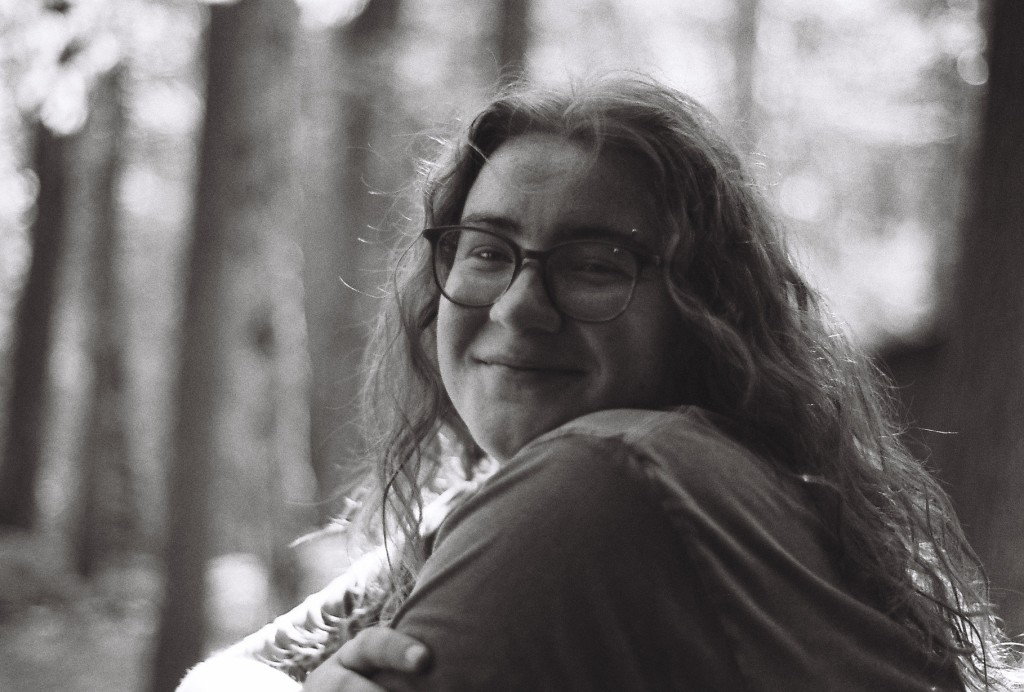
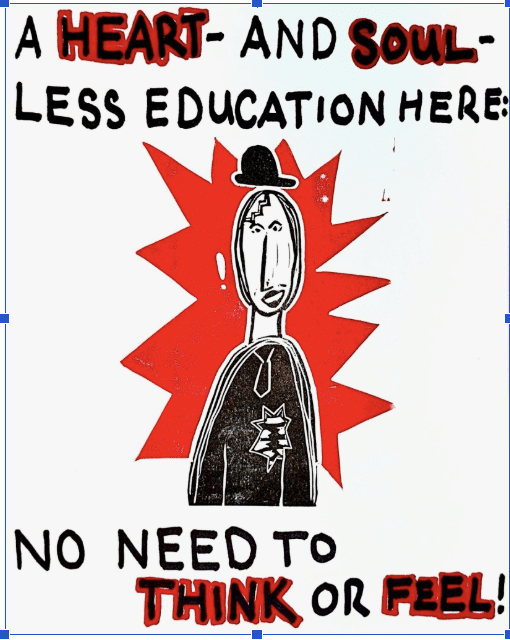
Brianna Jarvis is a recent graduate of the University of Michigan who studied Ecology, Evolution, & Biodiversity and Creative Writing. Brianna uses linocut printmaking and writing to connect their passion for art, science, literature, and the human spirit. Most of their work has something to say about human experience within the natural world, and critiques the abuse of power through restrictive structures like surveillance, binaries, violence, and more.
Artist’s Statement: I am anti-generative AI through and through. I think that it is so damaging to 1) the environment and those communities living near and far to data centers, 2) art and the sanctity and novelty of art, and 3) humanity’s ability to think and feel for themselves. I think that the deployment of so many AI features and components everywhere you look is a direct strategy to decrease critical thinking skills. Admittedly, it scares me. I was often enraged by my university’s insistence on AI in the classroom. This piece was my attempt at making something really human to call that out.
Author